

Quick Summary
- Insulin resistance means that tissues such as skeletal muscle, liver, and fat respond less effectively to insulin. The pancreas can compensate by producing more insulin, sometimes keeping blood glucose normal for years.
- Insulin resistance is associated with metabolic syndrome, prediabetes, type 2 diabetes, fatty liver disease, and PCOS, but it is not the sole cause of these conditions and does not explain every case of fatigue or weight gain.
- Insulin sensitivity can improve. Regular physical activity, resistance training, appropriate nutrition, sufficient sleep, weight management when appropriate, and medical treatment when indicated can all improve metabolic health.
Table of Contents
Myth vs. Fact
Myth: "Only people with diabetes need to worry about insulin."
Fact: Insulin resistance can develop before diabetes is diagnosed. In early insulin resistance, the pancreas can increase insulin secretion enough to keep blood glucose within the normal range. This means a person can have increasing metabolic risk while a routine glucose test still appears reassuring.
Myth: "If my fasting blood sugar is normal, my insulin metabolism must be normal."
Fact: Normal fasting glucose does not necessarily mean normal insulin sensitivity. The pancreas may be compensating for reduced tissue responsiveness by secreting more insulin.
However, there is an important medical distinction: fasting insulin is not a standardized routine diagnostic test for insulin resistance in most clinical settings. HOMA-IR, which is calculated using fasting glucose and insulin, also has limitations and does not have one universally accepted cutoff that can diagnose insulin resistance in every individual.
Myth: "Insulin resistance means I caused my condition by eating too much sugar."
Fact: Insulin resistance is biologically complex. Excess body fat, particularly visceral fat, physical inactivity, genetics, sleep disruption, certain medications, PCOS, and other metabolic factors can contribute.
Eating patterns matter, but insulin resistance should never be reduced to a moral judgment about how someone eats.
The Biology: Insulin Resistance Explained With a Key and Lock
Imagine that every muscle cell in your body has a locked door.
Glucose, the sugar produced from the food you eat, is one of the body's major sources of energy. After a meal, glucose enters the bloodstream. Insulin acts as an important hormonal signal that helps the body respond to this incoming energy.
Think of insulin as part of the key system that helps open the door.
When insulin binds to its receptor on a cell, it activates a chain of signals inside the cell. In skeletal muscle, one important effect is the movement of glucose transporter proteins called GLUT4 to the cell surface. These transporters allow glucose to move from the bloodstream into muscle cells.
Now imagine that the lock gradually becomes harder to operate.
The insulin signal is still present. The insulin receptor is still there. But the cell's response to the signal has become weaker.
That is insulin resistance.
The pancreas responds to this reduced effectiveness by increasing insulin secretion in an attempt to maintain normal blood glucose. This can result in hyperinsulinemia, meaning higher circulating insulin levels.
Eventually, if the pancreas can no longer compensate adequately for the degree of insulin resistance, blood glucose begins to rise. This can progress from normal glucose regulation to prediabetes and, in some people, eventually type 2 diabetes.
The biology is more complicated than a single "lock," because insulin resistance can affect several organs in different ways.
In skeletal muscle, insulin-stimulated glucose uptake becomes less effective.
In the liver, insulin normally suppresses glucose production. With hepatic insulin resistance, this suppression becomes less effective, allowing the liver to continue producing glucose when it should be reducing production.
In adipose tissue, insulin normally suppresses lipolysis, the breakdown and release of stored fat. Insulin resistance can impair this regulation and contribute to abnormal fatty-acid release and metabolic dysfunction.
So insulin resistance is not simply "having too much insulin." It is a state of reduced biological responsiveness to insulin across important metabolic tissues, often accompanied by compensatory increases in insulin secretion.
The Progression Timeline
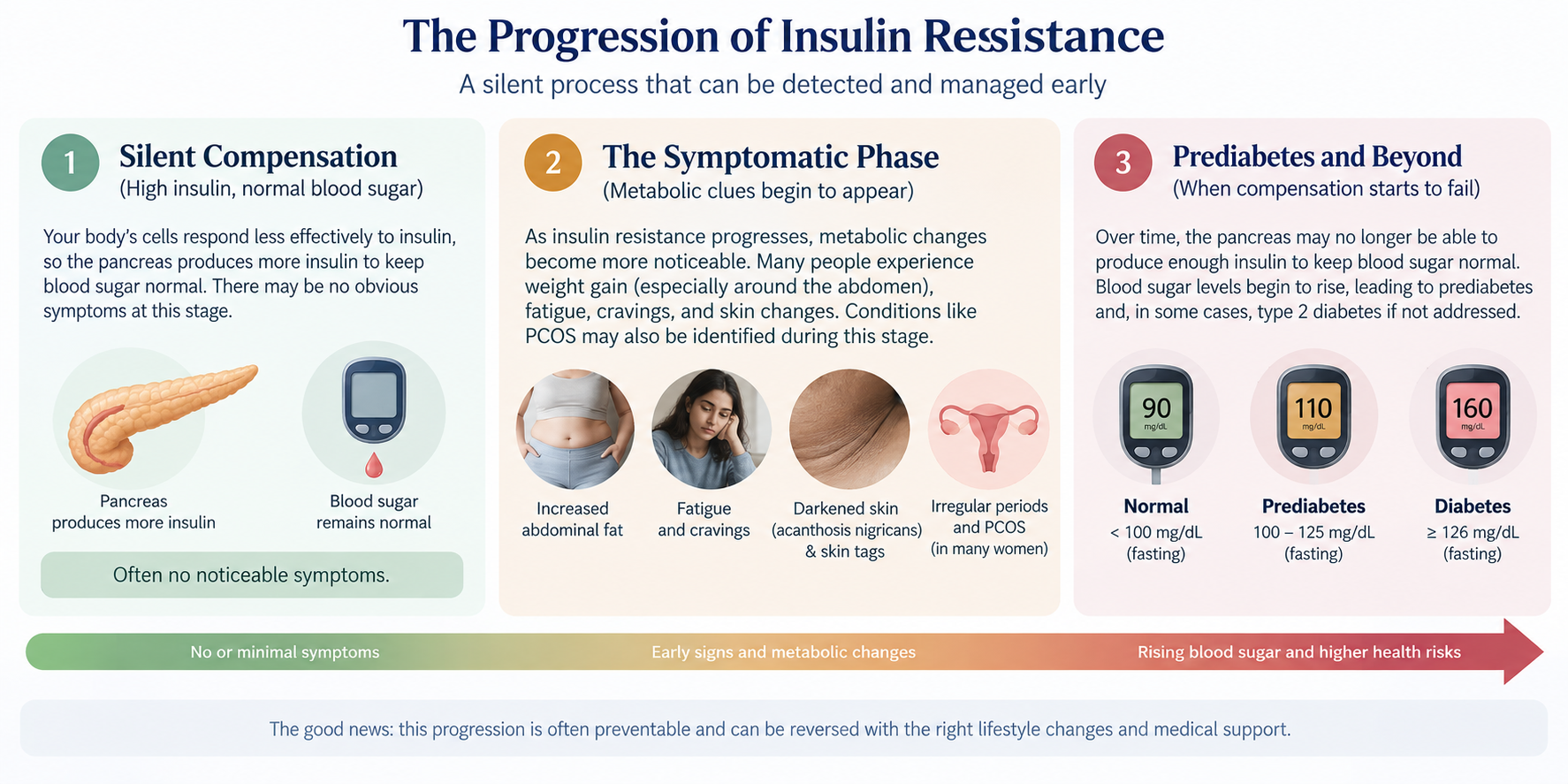
Phase 1: Silent Compensation : High Insulin, Normal Blood Sugar
This is the stage that can be particularly confusing.
The body's tissues are becoming less responsive to insulin, but the pancreas is still capable of increasing insulin secretion. As a result, fasting glucose and HbA1c may remain within the normal range.
There may be no obvious symptoms at all. Insulin resistance and prediabetes are frequently silent in their early stages.
This is why a normal glucose result does not always tell the entire metabolic story, particularly in someone with significant risk factors.
At the same time, this does not mean that everyone with normal glucose should undergo extensive insulin testing. Clinical risk factors, medical history, examination findings, and standard glucose-based tests should guide evaluation.
Phase 2: The Symptomatic Phase : Metabolic Clues Begin to Appear
As metabolic dysfunction progresses, some people begin noticing patterns rather than one specific symptom.
Weight may become easier to gain and harder to lose. Abdominal fat accumulation may become more prominent. Hunger and cravings can become difficult to manage. Some people develop acanthosis nigricans, a velvety darkening and thickening of the skin, commonly around the neck, armpits, or groin. Skin tags can also occur in association with insulin resistance.
Fatigue can occur, but it requires an important medical caveat: fatigue is nonspecific. Insulin resistance may contribute to metabolic dysfunction and altered energy regulation, but persistent fatigue can also result from anemia, thyroid disease, sleep apnea, depression, medication effects, nutritional deficiencies, chronic illness, and many other causes.
PCOS is another important part of the conversation.
Insulin resistance is a recognized feature of polycystic ovary syndrome (PCOS) and can interact with ovarian hormone pathways. However, PCOS is a complex endocrine disorder and should not be reduced to simply "insulin resistance in women."
The metabolic and reproductive features of PCOS can influence one another, which is why appropriate evaluation should consider both hormonal and metabolic health.
Phase 3: Prediabetes and Beyond : When Compensation Starts to Fail
Eventually, the pancreas may no longer be able to compensate adequately for the body's insulin resistance.
It is more accurate to describe this as progressive beta-cell dysfunction rather than simply saying that the pancreas becomes "tired." Pancreatic beta cells can gradually lose the ability to secrete enough insulin relative to the body's metabolic demands.
Blood glucose then begins to rise.
Prediabetes can be identified through glucose-based testing such as HbA1c, fasting plasma glucose, or a 2-hour oral glucose tolerance test.
This transition is not inevitable. Metabolic risk can be modified, and progression toward type 2 diabetes can often be prevented or delayed through lifestyle changes and, when appropriate, medical treatment.
The 4-Pillar Action Plan
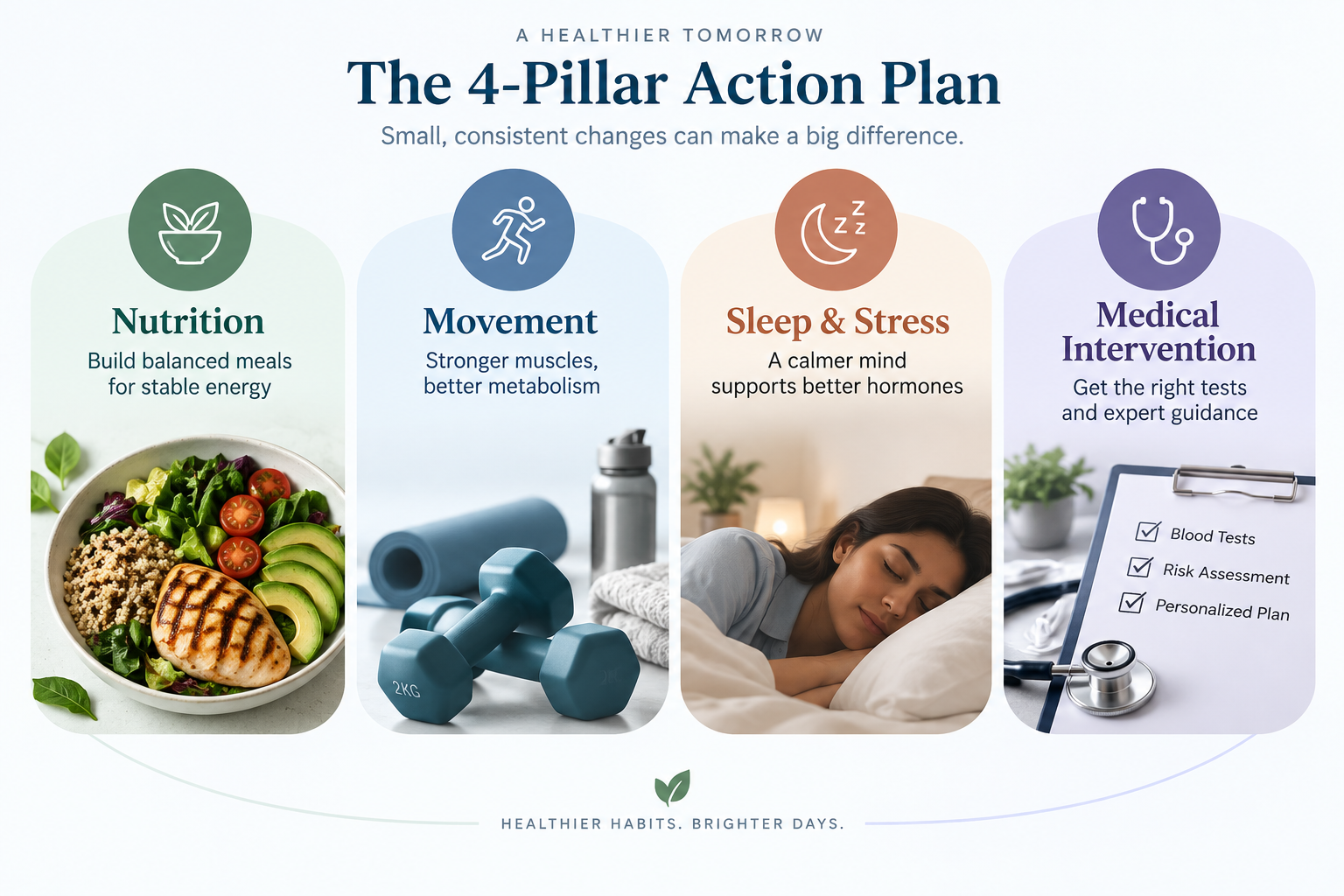
Nutrition: Build Meals Around Metabolic Stability
"Eat healthy" is technically correct but practically incomplete.
A more useful approach is to build meals around fiber-rich foods, adequate protein, minimally processed carbohydrates, and healthy fats, while paying attention to portions and the overall dietary pattern.
One practical technique is meal sequencing: eat non-starchy vegetables or other fiber-rich foods first, protein next, and carbohydrate-rich foods later in the meal.
Research suggests that consuming vegetables and protein before carbohydrates can reduce the magnitude of post-meal glucose excursions compared with eating carbohydrates first.
For example, instead of starting a meal with a large serving of rice or bread and eating vegetables afterward, you could begin with a vegetable-rich salad or cooked vegetables, eat your protein source, and then have your rice, roti, potatoes, or other carbohydrate portion.
This is not a magical "insulin hack," and it does not make carbohydrates unhealthy. The larger principle matters more: fiber, protein, food quality, total dietary intake, and sustainability are more important than obsessively trying to eliminate every glucose spike.
Movement: Turn Your Muscles Into a Glucose Sink
Skeletal muscle is one of the body's major sites for glucose disposal.
When muscles contract during physical activity, glucose uptake can increase through pathways that are partly independent of insulin. Regular physical activity also improves insulin sensitivity over time.
This is why exercise is not simply a calorie-burning tool.
Resistance training helps build and preserve muscle tissue. Aerobic exercise improves cardiovascular fitness and insulin sensitivity. Moderate-intensity aerobic exercise, often described in fitness settings as Zone 2, can be a useful way to accumulate sustainable aerobic activity, although there is nothing uniquely magical about the Zone 2 label itself.
A practical approach is to combine resistance training with regular aerobic activity and frequent movement throughout the day. Breaking up long periods of sitting with short bouts of movement can also be useful.
The goal is not punishment.
The goal is to make your muscles more metabolically active and improve how efficiently your body handles glucose.
Sleep and Stress: Understand the Cortisol-Insulin Connection
Your metabolism does not operate independently of your nervous system.
During stress, the hypothalamic-pituitary-adrenal axis helps coordinate the body's response, including changes in cortisol. Cortisol helps make energy available by influencing glucose production and metabolism.
Chronic psychological stress, altered cortisol regulation, and poor sleep can all interact with metabolic health.
Sleep matters particularly because insufficient or disrupted sleep can reduce insulin sensitivity and alter appetite, glucose regulation, and other metabolic processes.
This does not mean that every person with insulin resistance has "high cortisol." It also does not mean that supplements marketed as "cortisol blockers" will fix metabolism.
It means something much more practical:
Sleep is part of metabolic health, not a luxury.
Consistent sleep timing, adequate sleep duration, treatment of suspected sleep apnea, and realistic stress-management strategies deserve a place alongside nutrition and exercise.
Medical Intervention: Know When to Get Evaluated
If you have unexplained weight gain, PCOS, a larger waist circumference, acanthosis nigricans, a family history of type 2 diabetes, a history of gestational diabetes, high blood pressure, abnormal triglycerides, fatty liver disease, or other metabolic risk factors, discuss appropriate screening with your doctor.
The most clinically established tests evaluate blood glucose, rather than simply looking for a high insulin number.
What Tests to Ask Your Doctor For
| Test | What it tells you | Important point |
|---|---|---|
| HbA1c | Estimates average blood glucose exposure over roughly the previous 2–3 months | Useful for screening and diagnosis, but can be affected by conditions that alter red blood cells or hemoglobin |
| Fasting Plasma Glucose | Measures blood glucose after fasting | A standard test for detecting impaired fasting glucose and diabetes |
| 75-g Oral Glucose Tolerance Test (OGTT) | Shows how the body responds to a standardized glucose load | Particularly useful when more detailed assessment of glucose regulation is needed and is important in PCOS |
| Fasting Insulin | Measures circulating insulin at one point in time | Can provide context in selected situations, but is not a standardized routine diagnostic test for insulin resistance |
| HOMA-IR | Estimates insulin resistance using fasting glucose and insulin | Useful mainly as an estimate; there is no universally accepted clinical cutoff applicable to everyone |
For people with PCOS, metabolic screening deserves particular attention. Current international PCOS guidance considers a 75-g oral glucose tolerance test the most accurate assessment of glycemic status, regardless of BMI, while routine clinical insulin assays are not recommended as a primary measure of insulin resistance.
The distinction is important. If you ask your doctor for "insulin resistance testing," it may be more useful to discuss HbA1c, fasting plasma glucose, and, when appropriate, an OGTT, rather than assuming that a fasting insulin or HOMA-IR number alone can diagnose the condition.
Persistent fatigue also deserves a broader medical evaluation rather than automatically being attributed to insulin resistance.
Conclusion: Your Metabolism Is Not Your Enemy
Insulin resistance is not a moral diagnosis.
It is not proof that you are lazy. It is not evidence that you have failed at dieting. And it is not synonymous with diabetes.
It is a biological state in which the body's tissues become less responsive to insulin, often prompting the pancreas to compensate by producing more insulin. For some people, this process remains hidden for years before blood glucose begins to rise. For others, it contributes to a broader pattern involving abdominal adiposity, metabolic syndrome, fatty liver disease, PCOS, prediabetes, or type 2 diabetes.
But there is another side to this story.
Your metabolism is adaptable.
Improving insulin sensitivity does not require a perfect diet, punishing workouts, or eliminating every carbohydrate. It requires a sustainable combination of appropriate nutrition, regular movement, muscle-building exercise, sufficient sleep, stress management, and medical treatment when indicated.
And sometimes the first meaningful step is not losing weight.
Sometimes it is understanding what your body has been trying to tell you.
If you have been doing everything "right" and still feel that your body is working against you, you deserve a proper medical evaluation rather than another lecture about willpower.
Your body is not broken. Your biology is giving you information, and with the right information, there is a great deal you can do with it.