






What is Hernia Repair Surgery?
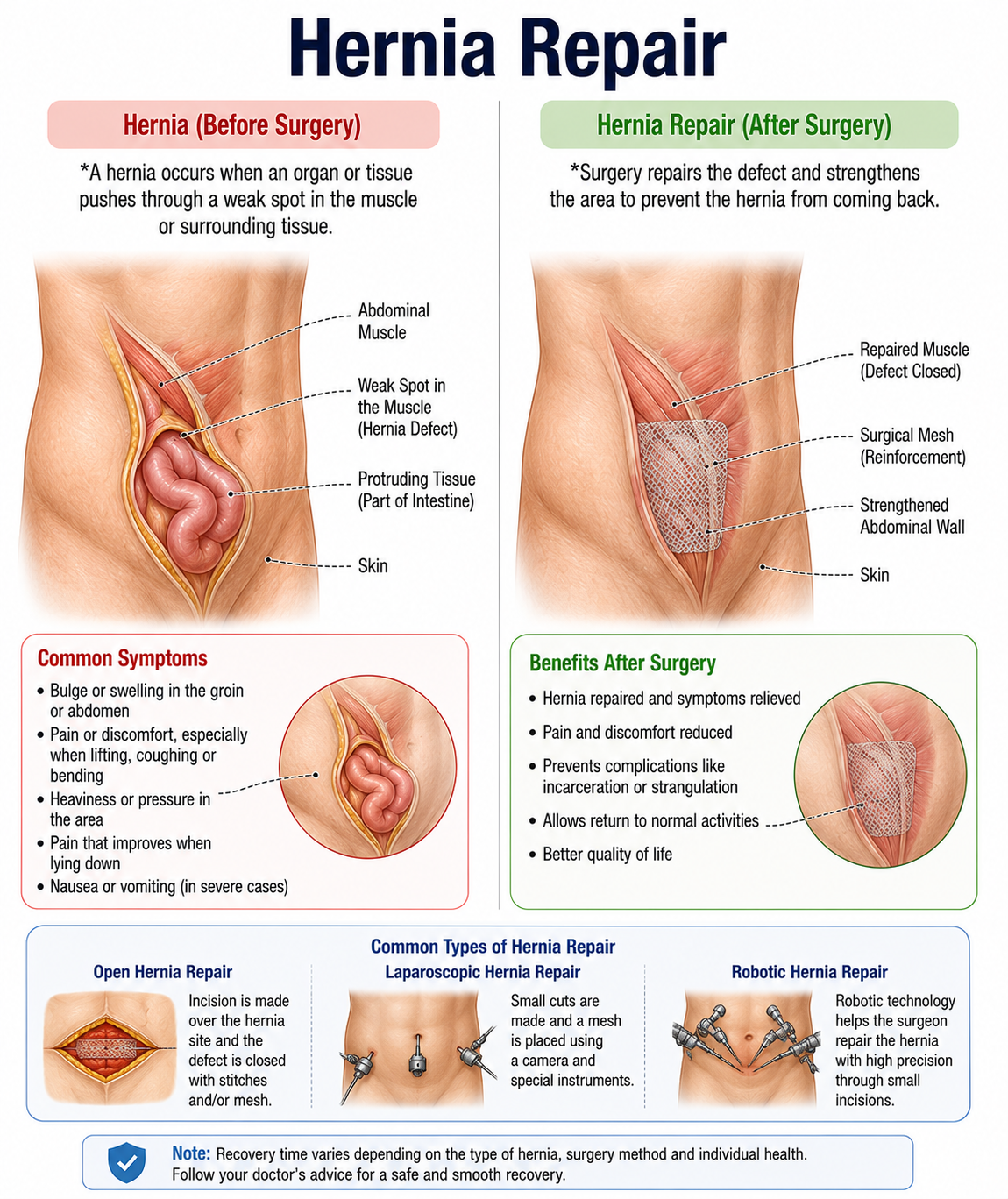
A hernia occurs when an internal organ or fatty tissue squeezes through a weak spot in the surrounding muscle or connective tissue. Hernia repair surgery repositions the herniated tissue back into the abdominal cavity and reinforces the weakened muscle area, usually with a synthetic medical-grade mesh.
Who Needs Hernia Repair Surgery?
Hernias do not heal on their own and tend to enlarge over time. Early elective repair prevents dangerous emergency complications like bowel strangulation or incarceration.
Key clinical indicators include:
- A visible or palpable bulge in the groin, navel, or surgical scar area.
- Pain or aching discomfort that worsens during standing, coughing, or heavy lifting.
- Incarceration (tissue stuck in the defect causing persistent severe pain).
- Signs of bowel obstruction (nausea, vomiting, inability to pass gas or stool).
Types of Hernias Repaired
- Inguinal Hernia: Located in the inner groin region (most common type).
- Umbilical / Paraumbilical Hernia: Located near or through the belly button.
- Incisional Hernia: Occurs at the site of a past abdominal surgical incision.
- Femoral Hernia: Occurs in the upper thigh/outer groin region.
Benefits of Hernia Repair
- Elimination of discomfort and visible abdominal swelling.
- Prevention of acute intestinal blockage or tissue strangulation.
- Durable reinforcement using lightweight medical mesh.
- Rapid resumption of routine daily physical activities.
What to Expect Before Surgery?
- Clinical Evaluation: Physical examination and ultrasonography or CT scan of the abdomen.
- Fitness Assessment: Routine blood tests, ECG, and chest X-ray for surgical clearance.
- Pre-Op Counseling: Guidance on bowel preparation and temporary cessation of blood thinners.
Complete Procedure
- Administration of spinal or general anesthesia.
- Creation of small keyhole incisions (laparoscopic) or a single groin incision (open).
- Identification and gentle reduction of the hernia sac back into the abdomen.
- Positioning of a high-strength surgical mesh over the muscle defect.
- Fixation of the mesh using sutures, tacks, or specialized tissue glue.
- Closure of skin incisions with absorbable sutures.
What to Expect During Surgery?
The procedure typically lasts between 45 and 90 minutes depending on hernia complexity and surgical technique. Recovery from anesthesia takes about 1 to 2 hours in the post-op ward.
Laparoscopic vs Open Hernia Mesh Repair
| Feature | Laparoscopic Repair | Open Repair |
|---|---|---|
| Technique | 3 Small Keyholes | 1 Direct incision over bulge |
| Bilateral Repair | Both sides repaired via same keyholes | Requires separate second incision |
| Post-Op Pain | Significantly minimal | Moderate |
| Return to Activity | 7 to 10 Days | 3 to 4 Weeks |
Success Rate and Safety
Modern hernia repair with tension-free mesh has a success rate exceeding 95-98%, with recurrence rates reduced to less than 2-3%.
Hernia Repair Cost Estimate
| Hernia Type | Open Mesh Surgery (INR) | Laparoscopic / Robotic Repair (INR) |
|---|---|---|
| Unilateral Inguinal / Umbilical | ₹45,000 - ₹80,000 | ₹75,000 - ₹1,30,000 |
| Bilateral / Complex Incisional | ₹70,000 - ₹1,20,000 | ₹1,10,000 - ₹1,80,000 |
Recovery Guide & Post-Operative Care
Recovery Timeline
- Day 0-1: Mobilization within hours of surgery; discharge same day or next day.
- Week 1: Normal walking and light household tasks; pain managed with oral medications.
- Week 2-3: Return to work and driving once pain-free.
- Week 6: Clearance for full physical exercise and heavy lifting (>10 kg).
Post-Op Precautions & Care
- Avoid Straining: Use stool softeners to prevent constipation and abdominal pressure.
- Support during Coughing: Support the repair site with a pillow when coughing or sneezing.
- Mesh Integration: Avoid high-impact heavy sports for 6 weeks.
Frequently Asked Questions
Can a hernia go away on its own without surgery?⌄
No, hernias do not heal spontaneously. Surgery is the only definitive treatment to repair the structural muscle defect.
Is the surgical mesh safe?⌄
Yes, modern synthetic meshes are biocompatible, thoroughly tested, and significantly reduce the risk of hernia recurrence.
How long will I stay in the hospital after hernia repair?⌄
Most keyhole hernia repairs are performed as day-care procedures or require a single overnight stay.
When can I resume lifting heavy weights after hernia surgery?⌄
Heavy lifting (above 5-10 kg) should be strictly avoided for 4 to 6 weeks to ensure the repair and mesh fully integrate.
What is the risk of a hernia coming back after repair?⌄
With modern mesh repair techniques, the recurrence rate is under 2% to 3%.