







What is Bypass Surgery (CABG)?
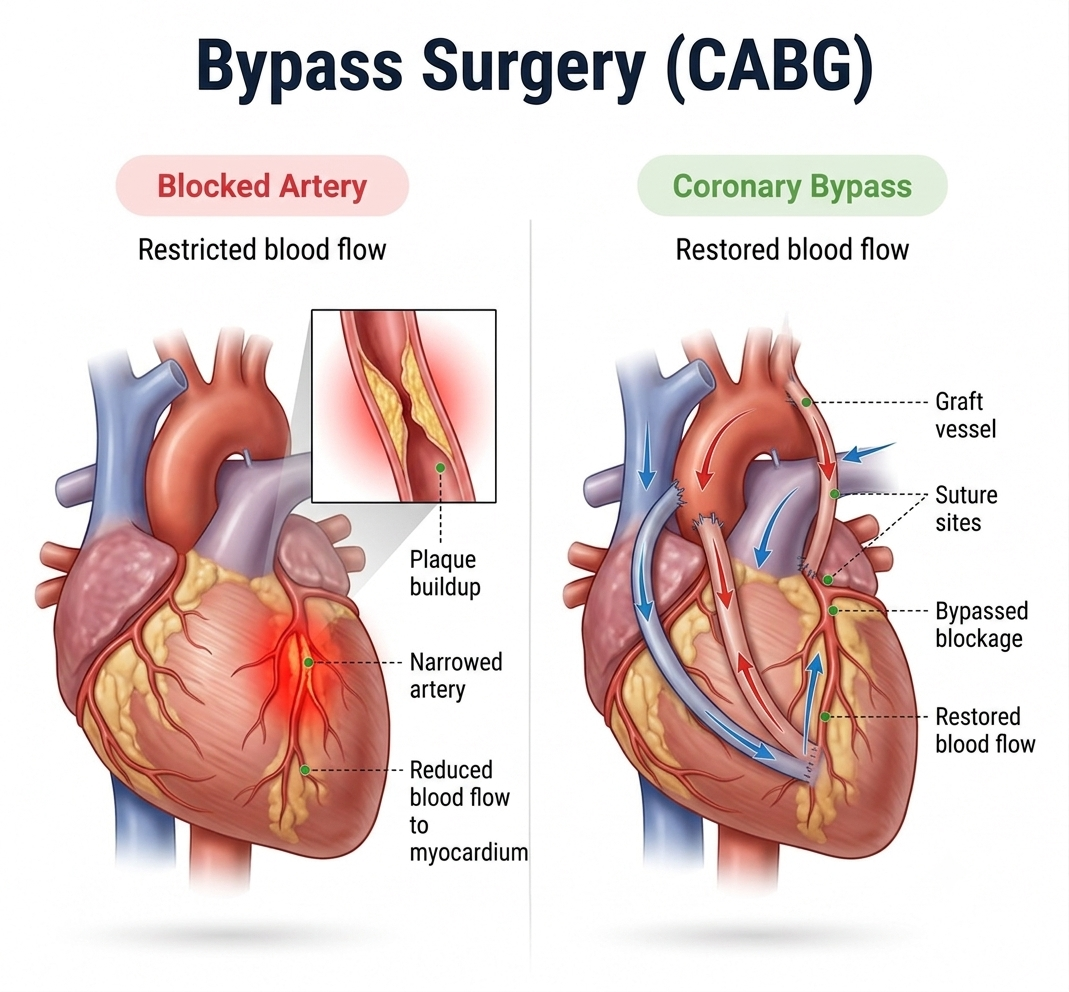
Coronary Artery Bypass Grafting (CABG) is a surgical intervention designed to redirect blood around narrow or clogged coronary arteries. Surgeons harvest a healthy blood vessel from the leg, arm, or chest and graft it above and below the blocked area. This restores oxygen-rich blood delivery to the myocardium (heart muscle), relieving severe angina and significantly reducing the risk of fatal heart attacks.
Who Needs Bypass Surgery?
CABG is typically recommended for patients with extensive coronary artery disease where less invasive options like angioplasty and stenting are unsuitable or insufficient.
Key clinical indicators include:
- Severe disease in the Left Main Coronary Artery (LMCA).
- Triple Vessel Disease (narrowing in all three main coronary arteries).
- Recurrent chest pain (angina) unresponsive to medication.
- Coronary artery blockages combined with impaired left ventricular function (reduced ejection fraction).
- Diabetes mellitus combined with multi-vessel coronary artery blockages.
Types of Bypass Surgery
- Traditional On-Pump CABG: The heart is temporarily stopped during the procedure, and a heart-lung bypass machine maintains blood circulation and oxygenation.
- Off-Pump / Beating Heart CABG: Performed on a beating heart using specialized stabilizing equipment, eliminating the need for a heart-lung machine.
- Minimally Invasive Direct CABG (MIDCAB): Performed through small incisions between the ribs rather than opening the sternum, ideal for single-vessel anterior blockages.
- Total Arterial Revascularization: Uses only arterial grafts (e.g., internal mammary or radial arteries) which offer superior long-term durability compared to vein grafts.
Note on Innovation: Robotic-assisted CABG allows precision internal mammary artery harvesting and minimally invasive grafting with minimal tissue trauma.
Benefits of Bypass Surgery
- Marked relief from severe chest pain and breathlessness.
- Improved long-term survival in patients with multi-vessel CAD and diabetes.
- Lower risk of repeat interventions compared to complex stenting.
- Restoration of cardiac exercise capacity and daily physical tolerance.
What to Expect Before Surgery?
Preparation ensures cardiac stability and minimizes surgical risks:
- Pre-Operative Diagnostics: Coronary angiography, echocardiogram, chest X-ray, and carotid Doppler ultrasound.
- Medical & Metabolic Clearance: Blood sugar stabilization, kidney function check, and pulmonary evaluation.
- Medication Adjustments: Blood thinners (like aspirin, clopidogrel) are tailored or temporarily stopped under cardiologist guidance.
- Respiratory Preparation: Deep breathing exercises and incentive spirometry training prior to surgery.
Complete Procedure
The standard surgical sequence involves:
- Administration of general anesthesia and hemodynamic line placement.
- Harvesting healthy graft vessels (Internal Mammary Artery, Saphenous Vein, or Radial Artery).
- Median sternotomy (opening the chest through the breastbone) or mini-thoracotomy.
- Connecting the heart-lung machine (if on-pump) or placing beating-heart stabilizers (if off-pump).
- Precision suturing of grafts above and below the arterial blockages.
- Re-warming, weaning off the heart-lung machine, and checking graft blood flow with transit-time flow probes.
- Placing chest drainage tubes, rewiring the sternum securely, and closing skin incisions.
What to Expect During Surgery?
Surgical duration ranges from 3 to 6 hours depending on the number of bypass grafts required. Continuous invasive arterial and venous monitoring takes place throughout. Post-surgery, the patient is transferred directly to the Cardiac Surgical ICU on a mechanical ventilator until stable.
Off-Pump vs Traditional On-Pump CABG
| Feature | Traditional On-Pump | Off-Pump (Beating Heart) |
|---|---|---|
| Heart State | Stopped using cardioplegia solution. | Actively beating using local mechanical stabilizers. |
| Blood Circulation | Heart-lung machine (CPB). | Patient's own cardiac pumping action. |
| Neurological Risk | Slightly higher risk of transient memory issues/stroke. | Reduced risk of cognitive changes and stroke. |
| Indication | Complex multi-vessel disease and deep vessels. | High-risk patients with aortic calcification or kidney issues. |
Success Rate and Safety
CABG holds an overall success rate exceeding 95-97% in elective cases. Arterial grafts demonstrate superior longevity, with internal mammary artery grafts remaining clear for over 15-20 years in over 90% of patients.
Bypass Surgery Cost Estimate
| Procedure Type | Standard Ward / Semi-Private (INR) | Deluxe / Private Ward (INR) |
|---|---|---|
| Single / Double CABG (Conventional) | ₹2,50,000 - ₹4,00,000 | ₹4,00,000 - ₹5,50,000 |
| Triple / Quadruple CABG (Off-Pump) | ₹3,00,000 - ₹4,50,000 | ₹4,50,000 - ₹6,50,000 |
| Minimally Invasive / Robotic CABG | ₹4,50,000 - ₹6,00,000 | ₹6,00,000 - ₹8,50,000+ |
Disclaimer: Costs vary based on hospital tier, co-morbidities (diabetes, renal status), length of ICU stay, and specific blood products/support needed.
Recovery Guide & Post-Operative Care
Recovery Timeline
- Day 0-2: ICU monitoring, weaning off ventilator, early mobilization out of bed.
- Day 3-6: Step-down ward care, progressive walking in hall, removal of chest tubes.
- Week 2-4: Home rest, sternal wound care, light indoor walking.
- Week 6-8: Sternum solidifies; driving and light work can be resumed after surgeon clearance.
- Month 3: Cardiac rehabilitation completion and return to regular routine.
Post-Op Precautions & Care
- Sternal Precautions: Avoid pulling, lifting (>3 kg), or pushing up with arms for 6-8 weeks to allow breastbone healing.
- Incision Care: Daily clean, dry management of chest and leg wounds; watch for redness or discharge.
- Cardiac Rehab: Structured exercise program to build cardiovascular stamina safely.
- Lifestyle Modification: Strict lifelong control of hypertension, lipid levels, blood sugar, and complete smoking cessation.
Frequently Asked Questions
How long will a bypass graft last?⌄
Arterial grafts (such as the Internal Mammary Artery) can last over 20 years, whereas vein grafts typically remain open for 10-12 years before narrowing may recur.
Is off-pump bypass surgery safer than on-pump?⌄
Off-pump surgery reduces the risk of stroke, bleeding, and lung/kidney complications, especially in elderly or high-risk patients, though both techniques yield excellent long-term results.
When can I resume driving and working after CABG?⌄
Most patients can return to light desk jobs within 6 to 8 weeks. Driving is permitted after 6 to 8 weeks once the chest bone (sternum) has fully healed.
Will I still need cardiac medications after bypass surgery?⌄
Yes, medications such as antiplatelets, statins, and beta-blockers are vital to protect the new grafts and prevent disease progression in other blood vessels.
How soon can I walk after bypass surgery?⌄
Patients are encouraged to sit up on the day after surgery and begin short walking exercises in the room or corridor by Day 2 or 3 under physiotherapy supervision.