
Quick Summary
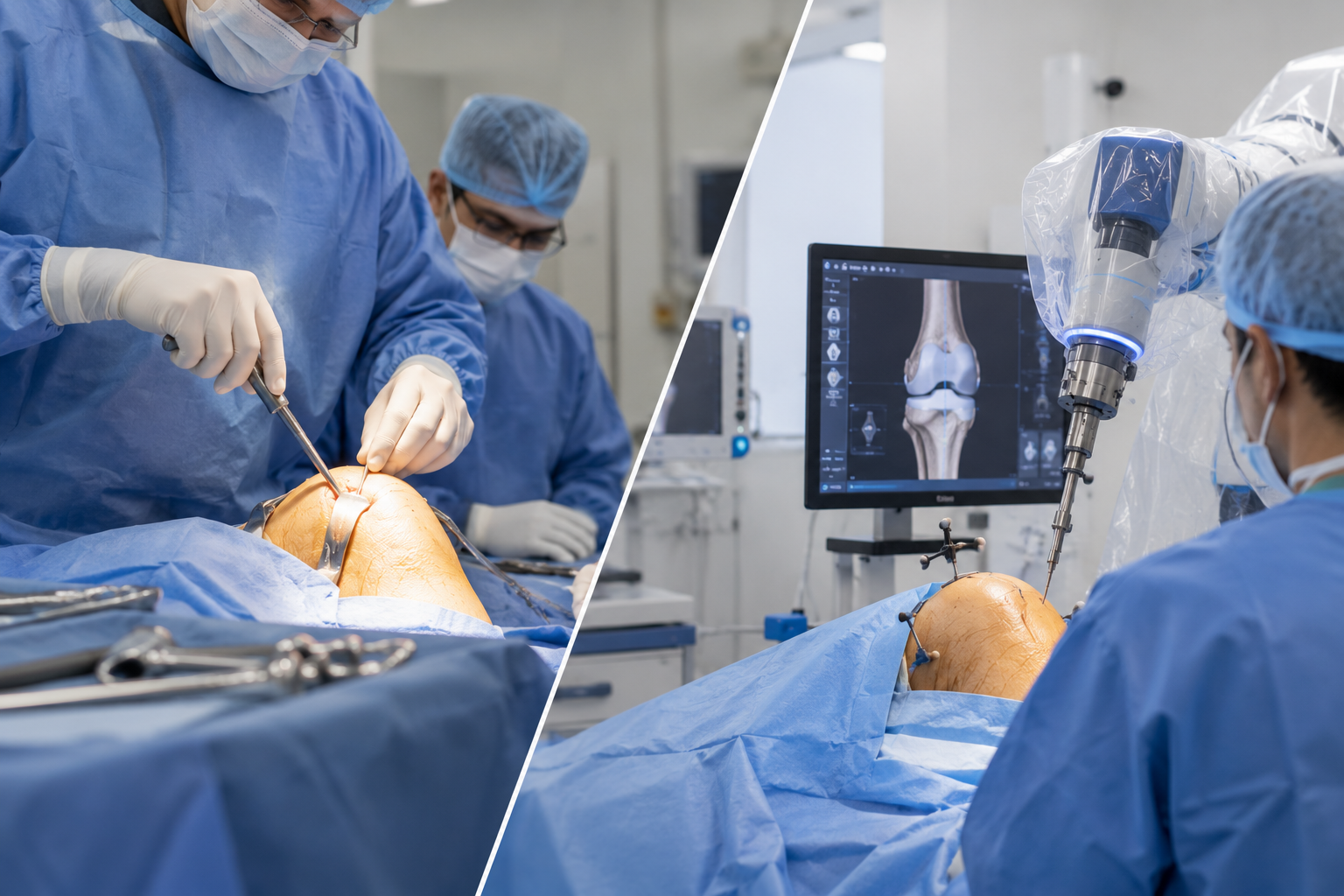
- Robotic-assisted knee replacement provides more precise and consistent implant positioning.
- Both robotic and conventional surgery can significantly improve pain and function.
- Greater precision does not always lead to better patient outcomes or fewer complications.
- Surgeon experience, implant choice, rehabilitation, and patient factors remain highly important.
Table of Contents
- 1. Understanding the Fundamentals
- 2. What Is Traditional Knee Replacement?
- 3. What Is Robotic-Assisted Knee Replacement?
- 4. How Traditional Knee Replacement Works
- 5. How Robotic-Assisted Knee Replacement Works
- 6. The Clinical Differences: What Does the Evidence Actually Show?
- 7. Who May Benefit More From Robotic Assistance?
- 8. When Traditional Knee Replacement May Be the Better Choice
- 9. The Surgeon Matters More Than the Machine
- 10. What Should You Ask Your Orthopaedic Surgeon?
- 11. Traditional vs Robotic Knee Replacement: At a Glance
- 12. So, Is Robotic Knee Replacement Worth the Extra Cost?
- 13. The Final Verdict
Understanding the Fundamentals
Before comparing the two techniques, it is important to understand what actually happens during a knee replacement.
What Is Knee Replacement Surgery?
Total knee replacement, also called total knee arthroplasty (TKA), is a procedure in which damaged surfaces of the knee joint are removed and replaced with artificial components.
In advanced osteoarthritis, the protective cartilage covering the ends of the femur and tibia becomes severely damaged. This can lead to bone-on-bone contact, inflammation, stiffness, deformity, and persistent pain.
During total knee replacement, the surgeon removes the damaged joint surfaces and prepares the ends of the femur and tibia to receive prosthetic components. A plastic bearing is placed between the metal components to allow smooth movement.
The goal is not simply to "replace the knee." The surgeon must also restore appropriate alignment, balance the surrounding soft tissues, position the components accurately, and create a stable knee that functions well during everyday movement.
What Is Traditional Knee Replacement?
Traditional or conventional knee replacement uses established surgical techniques and instruments to guide bone preparation and implant positioning.
The surgeon evaluates the patient's X-rays, physical examination, deformity, ligament stability, bone quality, and overall anatomy before surgery. During the procedure, standard cutting guides and anatomical landmarks are used to make the required bone cuts and position the implant.
The surgeon makes continuous decisions throughout the operation based on the patient's anatomy and the behavior of the knee after the bone cuts are made.
This approach has been used successfully for decades and has an extensive body of clinical evidence supporting its effectiveness.
Traditional does not mean outdated.
A well-performed conventional knee replacement by an experienced surgeon can provide excellent pain relief, function, and implant longevity.
What Is Robotic-Assisted Knee Replacement?
Robotic-assisted knee replacement combines conventional surgical principles with computer-assisted planning and robotic technology.
Depending on the system, planning may use a preoperative CT scan or an image-free, intraoperative mapping process. The patient's anatomy is converted into a digital model or mapped in real time.
The surgeon can then plan important parameters such as:
- Implant size
- Implant position
- Bone resection
- Limb alignment
- Joint-line restoration
- Soft-tissue balance
During surgery, the robotic system provides guidance based on this plan.
Importantly, the robot does not independently perform the operation. The surgeon remains in control and performs the procedure.
Some robotic systems provide a physical or software-controlled boundary that helps keep bone preparation within the planned area. Other systems function primarily as navigation or positioning tools. The exact technology varies between manufacturers and surgical platforms.
This distinction matters because "robotic knee replacement" is not one single technique. Different systems use different methods, and the clinical results depend not only on the technology but also on the surgeon's technique and the alignment philosophy being used.
How Traditional Knee Replacement Works
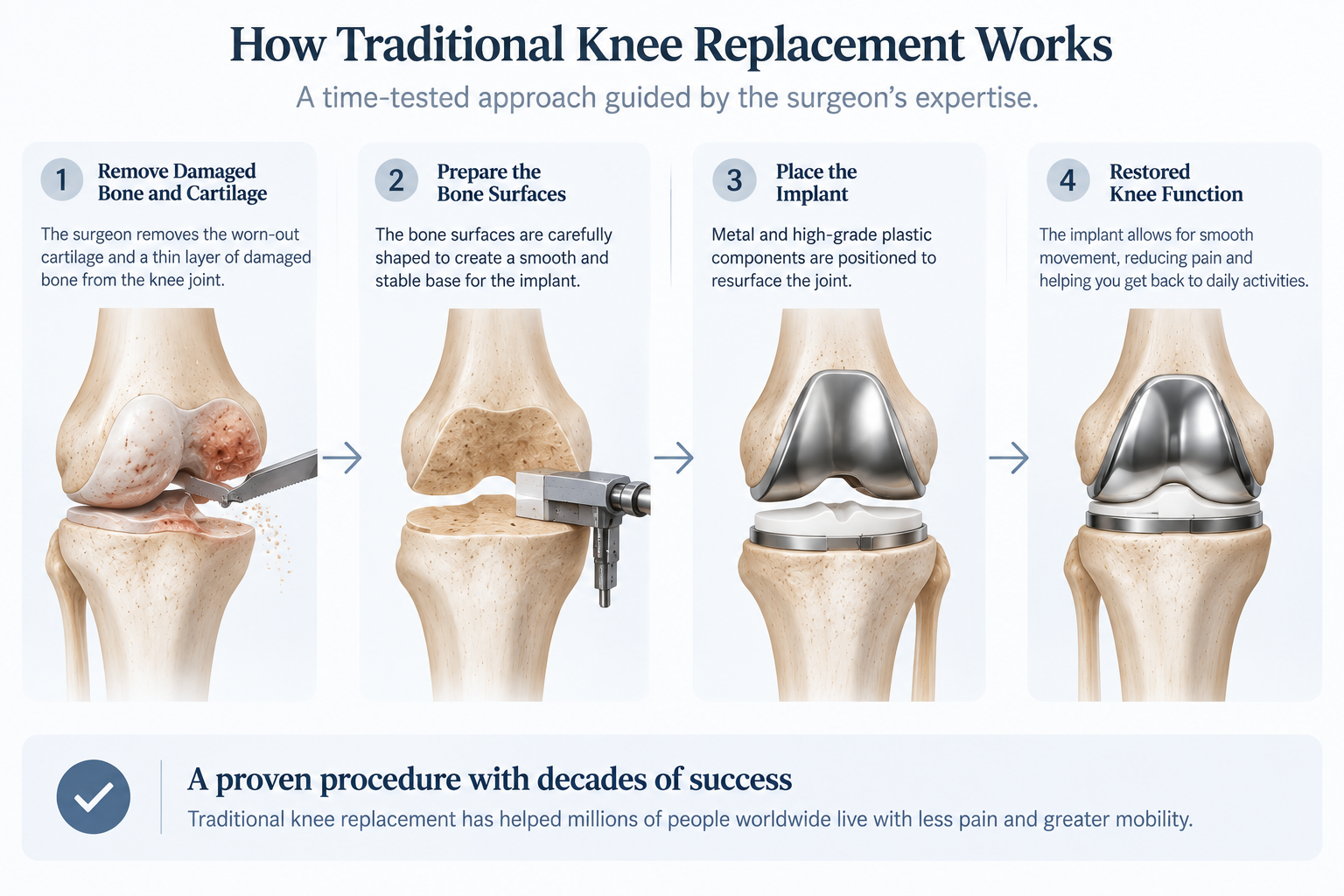
1. Removing the Damaged Joint Surfaces
The surgeon removes the damaged cartilage and a carefully measured amount of bone from the femur and tibia.
The amount removed is not arbitrary. It is determined by the surgical plan and the implant system being used.
2. Preparing the Bone
The exposed bone surfaces are shaped to create stable surfaces for the prosthetic components.
The surgeon also evaluates ligament tension and the overall balance of the knee. Achieving appropriate soft-tissue balance is an important part of producing a stable and functional replacement.
3. Positioning the Implant
The metal femoral and tibial components are positioned and secured. A polyethylene bearing is placed between them to provide a smooth articulating surface.
Depending on the implant design and surgical technique, the patella may also be resurfaced.
4. Testing the Knee
Before closing the incision, the surgeon moves the knee through its range of motion and evaluates stability, alignment, tracking, and soft-tissue balance.
The final objective is a knee that is stable, appropriately aligned, and capable of supporting comfortable movement.
How Robotic-Assisted Knee Replacement Works
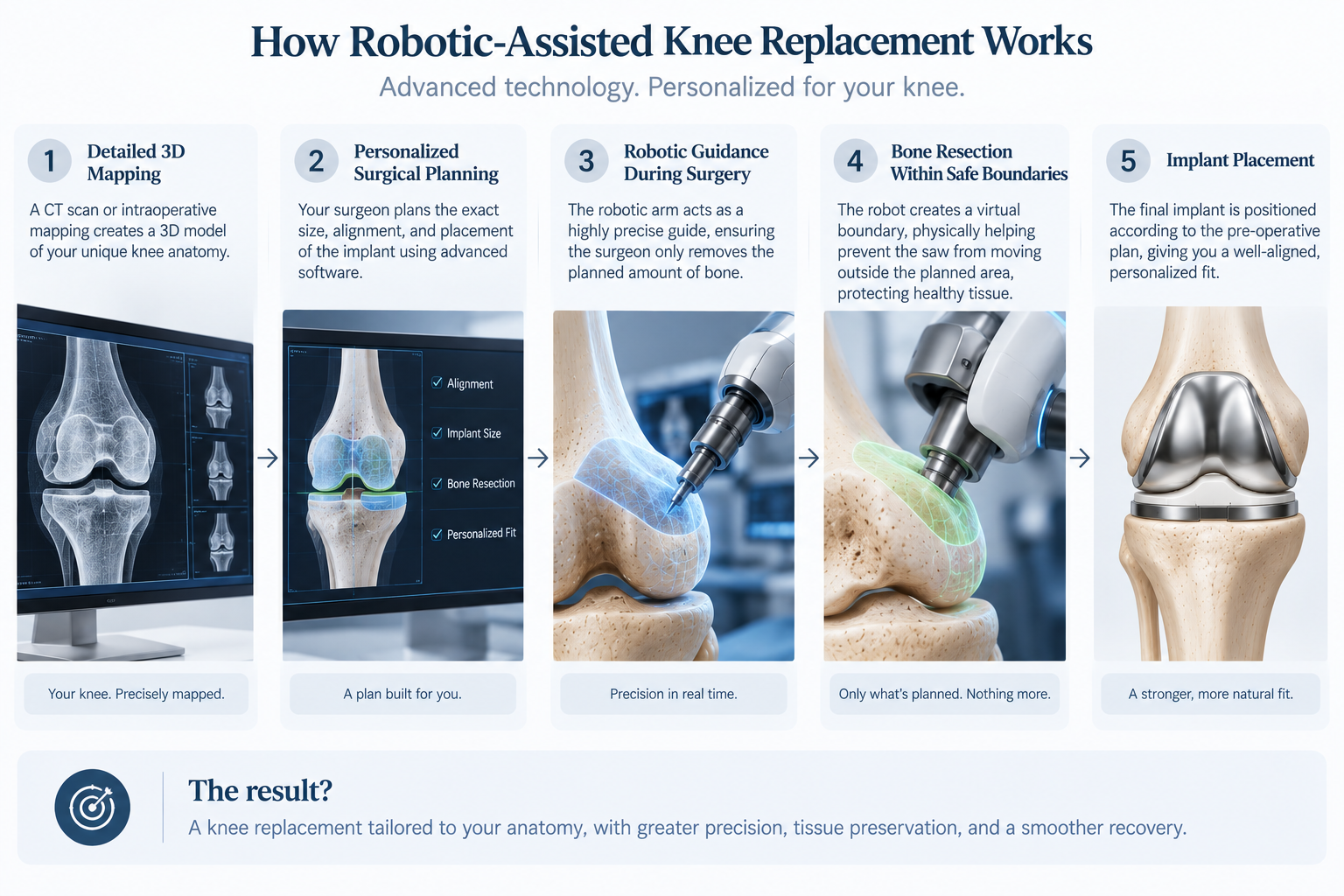
1. Creating a Detailed Map of the Knee
Depending on the robotic platform, the surgeon may use a CT-based 3D model or intraoperative mapping to understand the patient's anatomy.
This allows the surgical plan to be based on the patient's individual bone geometry rather than relying solely on standard anatomical measurements.
2. Creating a Personalized Surgical Plan
The surgeon can adjust the planned implant position, alignment, bone resections, and other parameters before making the definitive cuts.
The plan can also be modified during surgery when the surgeon evaluates the actual anatomy and soft-tissue behavior.
This is one of the major differences from conventional instrumentation: the surgeon receives detailed digital feedback throughout the procedure.
3. Robotic Guidance During Bone Preparation
The robotic system assists the surgeon in executing the surgical plan.
Depending on the system, this may involve navigation, real-time tracking, or a robotic arm that guides the surgical instrument.
The important point is that the robot assists; it does not make independent clinical decisions.
4. Controlled Bone Resection
Some systems provide a defined operating boundary that helps the surgeon stay within the planned area during bone preparation.
This can improve the reproducibility of bone cuts and reduce unintended deviations from the surgical plan.
5. Implant Placement and Final Verification
Once the bone preparation and balancing are satisfactory, the implant components are positioned.
The surgeon then verifies alignment, stability, range of motion, and overall function before completing the procedure.
The Clinical Differences: What Does the Evidence Actually Show?
The most important distinction between robotic and conventional knee replacement is not that one works and the other does not.
Both can work very well.
The strongest evidence for robotic assistance concerns precision and reproducibility of implant positioning.
1. Implant Alignment and Positioning
Robotic-assisted TKA generally produces fewer alignment outliers and more reproducible component positioning than conventional instrumentation.
A 2025 systematic review and meta-analysis of 21 randomized controlled trials involving 2,692 patients found that robotic-assisted TKA significantly reduced mechanical alignment outliers compared with conventional surgery. However, the same analysis did not find significant differences in commonly used functional scores such as WOMAC or Oxford Knee Scores at the assessed follow-up points.
This is an important distinction.
Better measurement does not automatically equal a dramatically better patient outcome.
Alignment is one component of a successful knee replacement, but pain, function, stability, rehabilitation, expectations, muscle strength, and overall health also influence the final result.
2. Bone and Soft-Tissue Preservation
Robotic systems can help surgeons plan bone cuts precisely and, depending on the technology used, control the execution of those cuts.
This may be particularly useful when anatomy is complex or when the surgeon is using a personalized alignment strategy.
However, it would be inaccurate to claim that robotic surgery always causes less tissue damage or less bleeding. Results vary by system, surgical technique, patient characteristics, and surgeon experience.
The evidence suggests potential advantages in some intraoperative measures, but these should not be presented as guaranteed benefits for every patient.
3. Pain and Early Recovery
This is where marketing claims often become stronger than the evidence.
Some studies report lower early postoperative pain, reduced opioid consumption, or improvements in early function with robotic-assisted surgery. Other studies find little or no clinically important difference between robotic and conventional approaches.
Recent evidence suggests that robotic-assisted TKA may provide some short-term advantages in selected outcomes, but these differences are generally much less dramatic than the differences in alignment accuracy.
Therefore, it would be misleading to tell every patient that choosing robotic surgery guarantees a faster or less painful recovery.
Recovery is also strongly influenced by pain-management protocols, preoperative conditioning, surgical technique, rehabilitation, sleep, nutrition, other medical conditions, and how consistently the patient participates in physiotherapy.
4. Implant Longevity
One of the most frequently repeated claims about robotic surgery is that greater precision automatically means a longer-lasting implant.
The biological reasoning is understandable: accurate component positioning may reduce certain mechanical problems associated with malalignment.
But the clinical evidence is more nuanced.
A 2025 meta-analysis comparing robotic and conventional TKA found no significant difference in implant survivorship at approximately 2 years, 2–5 years, or 10 years.
At the same time, individual long-term studies have reported potentially better aseptic survivorship with robotic-assisted surgery. For example, a 2025 retrospective study with at least 15 years of follow-up found fewer alignment outliers and lower aseptic mechanical failure in its robotic group, although the study design and loss to follow-up mean the results should be interpreted cautiously rather than treated as definitive proof of superiority.
The most accurate conclusion today is therefore:
Robotic assistance improves the precision of implant positioning, but whether that precision consistently translates into meaningfully longer implant survival remains an active area of research.
5. Operating Time and Cost
Robotic surgery requires additional technology, planning, equipment, and staff training. Depending on the system and hospital, it may also increase operating time and procedural costs.
A recent review found that robotic-assisted TKA was associated with longer operative time and higher intraoperative costs, while evidence regarding overall cost-effectiveness remained mixed.
This is why the price difference should not be viewed simply as paying for "better surgery."
You are paying for a particular surgical technology and workflow. Whether that additional expense is worthwhile depends on the clinical value it provides for your specific case.
Who May Benefit More From Robotic Assistance?
Robotic assistance may be particularly useful when the surgeon needs detailed control over alignment, bone preparation, or soft-tissue balance.
It can be considered in patients with:
- Significant anatomical variation or deformity
- Previous surgery that has altered normal anatomy
- Complex alignment requirements
- Specific personalized or functional alignment strategies
- Situations where the surgeon believes additional intraoperative planning and measurement will meaningfully improve the procedure
However, being young or physically active does not automatically mean robotic surgery is necessary.
Likewise, having straightforward knee anatomy does not mean robotic surgery is inappropriate.
The decision should be individualized rather than driven by age, marketing claims, or the assumption that newer technology is always superior.
When Traditional Knee Replacement May Be the Better Choice
Traditional knee replacement remains an excellent option for many patients.
If your anatomy is straightforward, your surgeon has extensive experience with conventional TKA, and cost is an important consideration, there may be little reason to choose a robotic procedure solely because it is newer.
The evidence to date does not show that robotic assistance makes conventional knee replacement obsolete.
A highly experienced surgeon performing a carefully planned conventional replacement can achieve excellent alignment and clinical outcomes.
In other words:
The absence of a robot does not mean the absence of precision.
The Surgeon Matters More Than the Machine
This is arguably the most important consideration when choosing between the two approaches.
A robotic system can improve planning and reproducibility, but it does not independently diagnose your problem, determine whether surgery is appropriate, select the ideal implant for your circumstances, manage unexpected anatomy, or take responsibility for the overall operation.
Those decisions remain with the surgeon.
When comparing hospitals or surgeons, consider:
How frequently does the surgeon perform knee replacements?
How experienced are they with the specific technique being offered?
Which implant system do they use, and why?
How do they evaluate alignment and soft-tissue balance?
What are their complication and revision rates?
What rehabilitation program do they use after surgery?
Is robotic assistance genuinely recommended for your knee, or is it simply the hospital's standard package?
These questions often tell you more about the likely quality of care than the presence of a robotic arm in the operating room.
What Should You Ask Your Orthopaedic Surgeon?
Before deciding, consider asking:
"Why are you recommending robotic or conventional surgery for my knee?"
A good surgeon should be able to explain the reasoning in relation to your anatomy rather than simply saying that one method is "better."
"Which robotic system do you use, and what does it actually do?"
Different systems work differently. Ask whether the technology uses CT-based planning, intraoperative navigation, or another method.
"Will the robot change my surgical plan?"
The technology should have a clinical purpose. If the surgeon cannot explain what additional information or control it provides in your case, the additional cost deserves careful consideration.
"How many knee replacements do you perform each year?"
Procedure volume and experience are important when evaluating a surgeon.
"What are your revision and complication rates?"
This can provide more meaningful information than a hospital's marketing claims about technology.
"What will my total cost be?"
Ask for the complete estimate, including surgeon fees, hospital charges, implants, investigations, anesthesia, robotic technology charges where applicable, physiotherapy, medications, and follow-up.
Traditional vs Robotic Knee Replacement: At a Glance
| Factor | Traditional Knee Replacement | Robotic-Assisted Knee Replacement |
|---|---|---|
| Surgeon controls the operation | Yes | Yes |
| Uses established surgical principles | Yes | Yes |
| Computer-assisted planning | Usually limited | Yes, depending on system |
| 3D anatomical mapping | Usually not required | Often used, depending on system |
| Implant positioning | Guided by conventional instruments and anatomical landmarks | Computer-assisted planning and robotic/navigation guidance |
| Alignment precision | Highly dependent on technique and surgeon experience | Generally more reproducible with fewer alignment outliers |
| Pain and recovery | Usually excellent with modern protocols | May offer some early advantages, but results are inconsistent |
| Long-term implant survival | Excellent established results | Promising, but superiority is not conclusively established |
| Cost | Generally lower | Generally higher |
| Best determinant of outcome | Surgeon expertise, planning, implant, rehabilitation, patient factors | The same, with additional technology |
So, Is Robotic Knee Replacement Worth the Extra Cost?
There is no universal yes-or-no answer.
If robotic assistance is being offered by a highly experienced knee replacement surgeon who uses the technology appropriately, it can provide genuine advantages in planning, measurement, alignment accuracy, and reproducibility.
For some patients, those advantages may justify the additional cost.
For others—particularly those with straightforward anatomy and significant financial constraints—the additional expense may not translate into a sufficiently meaningful improvement in their outcome.
The current evidence does not support telling every patient that robotic surgery guarantees less pain, faster recovery, or a longer-lasting implant. Recent comparative evidence generally shows that both robotic and conventional knee replacement can provide excellent clinical outcomes, while robotic surgery has its clearest advantage in the accuracy and reproducibility of component positioning.
The decision should therefore be based on your anatomy, your surgeon's expertise, your clinical goals, and the expected value of the technology—not simply the fact that it is robotic.
The Final Verdict
Robotic-assisted knee replacement is an important development in modern joint replacement surgery, but it should be viewed as an advanced surgical tool rather than a replacement for surgical expertise.
Traditional knee replacement remains a highly successful and extensively validated procedure. Robotic assistance can make certain parts of the operation more measurable and reproducible, particularly implant positioning and alignment.
What it cannot do is guarantee a perfect result.
Your outcome depends on much more than the machine: the indication for surgery, the surgeon's experience, the implant, your bone and soft-tissue anatomy, your general health, pain management, rehabilitation, and your expectations all matter.
If you are considering knee replacement, do not ask only:
"Does this hospital have a robot?"
Ask:
"Why is this technique appropriate for my knee, and what experience does my surgeon have performing it?"
That conversation is far more valuable than the technology label alone.
A robot can improve precision. It cannot replace judgment, experience, or good surgical decision-making.
Disclaimer
This article is intended for general educational purposes and should not be used as a substitute for an individual medical evaluation. The choice between conventional and robotic-assisted knee replacement depends on the patient's diagnosis, anatomy, medical history, surgeon expertise, available technology, and personal preferences. Discuss the potential benefits, limitations, risks, and costs of each approach with a qualified orthopaedic surgeon before making a treatment decision.