











What is Heart Valve Replacement?
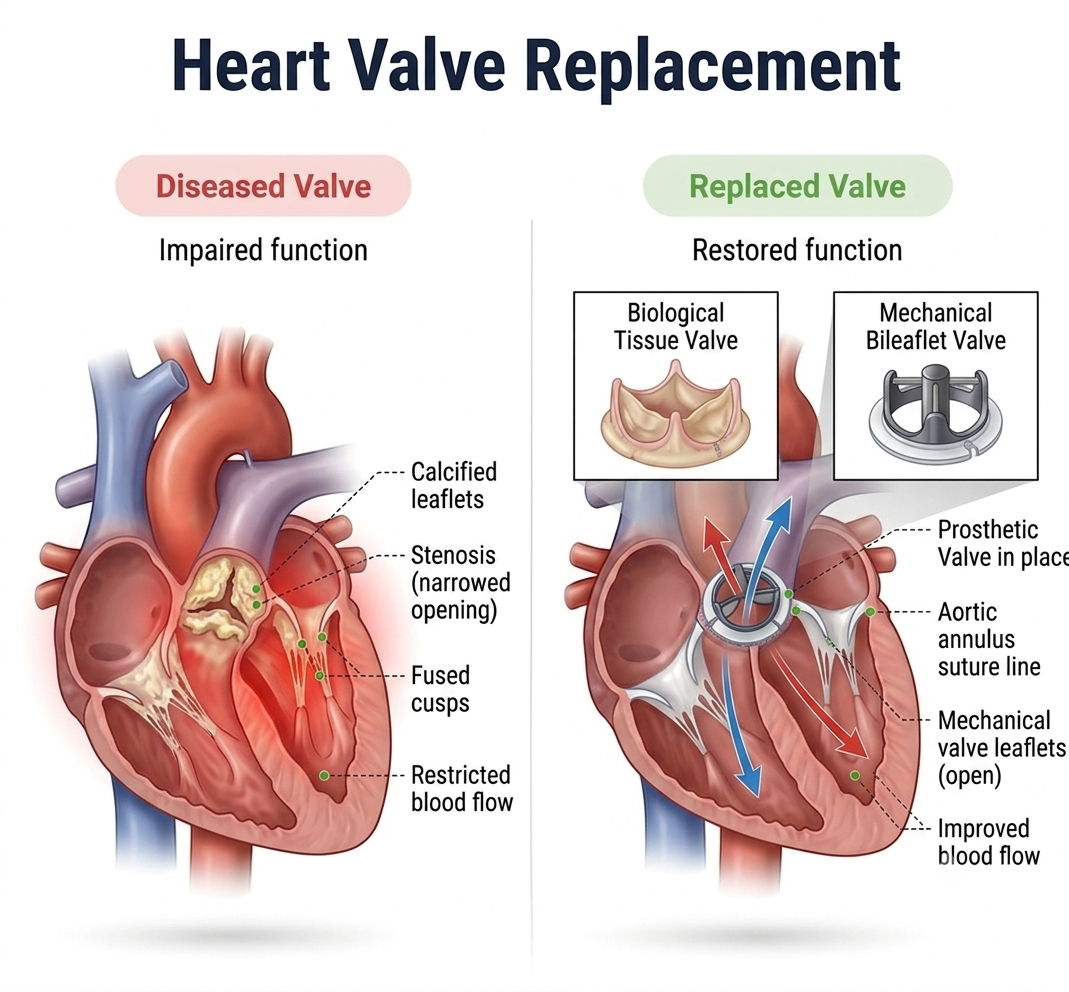
Heart Valve Replacement is performed when one of the heart's four valves (aortic, mitral, tricuspid, or pulmonary) suffers from severe stenosis (narrowing preventing forward blood flow) or regurgitation (leaking causing backward flow). The damaged valve leaflets are excised, and a new prosthetic mechanical or bioprosthetic tissue valve is sewn into the native valve ring, restoring unimpeded unidirectional blood flow through the heart chambers.
Who Needs Heart Valve Replacement?
Surgery is indicated when valve dysfunction compromises heart function, causing symptoms or left ventricular enlargement.
Key clinical indicators include:
- Severe Aortic Stenosis with fainting spells (syncope), chest pressure, or shortness of breath.
- Severe Mitral Regurgitation or Stenosis not suitable for valve repair.
- Progressive heart enlargement or declining ejection fraction on echocardiography.
- Rheumatic heart disease causing severe chronic damage to valve structures.
- Infective endocarditis causing destruction of valve tissue.
Types of Replacement Valves & Approaches
- Mechanical Valves: Crafted from pyrolytic carbon and titanium. Exceptionally durable (lasts a lifetime) but requires lifelong oral blood thinners (Warfarin/Acitrom).
- Tissue / Bioprosthetic Valves: Sourced from bovine (cow) or porcine (pig) pericardial tissue. Does not require lifelong blood thinners, but wears out after 12-18 years.
- TAVR / TAVI (Transcatheter Aortic Valve Replacement): Minimally invasive catheter-based replacement for aortic stenosis without open-chest surgery.
- Minimally Invasive Valve Surgery (MIVS): Performed through a small right mini-thoracotomy incision instead of splitting the breastbone.
Benefits of Heart Valve Replacement
- Complete elimination of life-threatening heart failure symptoms.
- Prevention of irreversible heart muscle weakening and pulmonary hypertension.
- Dramatic improvement in life expectancy and physical functional capacity.
- Restoration of normal blood flow dynamics throughout the circulatory system.
What to Expect Before Surgery?
Detailed anatomical and dental screening is vital prior to valve surgery:
- Echocardiogram & Cardiac MRI: Determining precise valve area, pressure gradients, and ventricular function.
- Coronary Angiogram: Checking for co-existing coronary artery blockages in patients over 40 years.
- Dental Clearance: Treating any dental caries or gum infections to prevent bacteremia and post-op valve infection (endocarditis).
- Anticoagulation Education: Understanding blood thinner management for mechanical valve recipients.
Complete Procedure
The open surgical replacement protocol includes:
- General anesthesia and transesophageal echocardiogram (TEE) probe insertion.
- Sternotomy or mini-thoracotomy access to the heart.
- Connecting the heart-lung machine and arresting the heart with cold cardioplegia solution.
- Opening the aorta or left atrium to visualize the diseased native valve.
- Carefully excising diseased, calcified valve leaflets and decalcifying the annulus.
- Placing multiple surgical sutures around the valve ring and securing the prosthetic valve tightly.
- Closing the heart, purging air bubbles under TEE guidance, restarting the heart, and wiring the chest.
What to Expect During Surgery?
Surgical duration is approximately 3.5 to 5 hours. Real-time TEE guidance is used inside the operating room to verify perfect prosthetic valve seating and absence of paravalvular leaks prior to transferring the patient to the Intensive Care Unit.
Mechanical Valves vs Tissue (Bioprosthetic) Valves
| Feature | Mechanical Valve | Biological Tissue Valve |
|---|---|---|
| Durability | Lifetime (>30+ years; virtually unlimited). | 12 to 18 years (may require re-intervention later). |
| Anticoagulation | Requires strict lifelong Warfarin/Acitrom & INR monitoring. | Requires aspirin or brief blood thinners (3 months only). |
| Ideal Patient Age | Younger patients (<60-65 years). | Older patients (>65 years) or women planning pregnancy. |
| Valve Sound | Soft, audible ticking sound in quiet settings. | Silent, identical to natural biological valve. |
Success Rate and Safety
Heart valve replacement carries a success rate of 95-98% in elective cases. Long-term functional outcomes are outstanding, allowing patients to regain an active lifestyle.
Heart Valve Replacement Cost Estimate
| Procedure Type | Mechanical Valve (INR) | Biological Tissue / TAVR (INR) |
|---|---|---|
| Single Valve Replacement (Aortic or Mitral) | ₹3,50,000 - ₹5,50,000 | ₹4,50,000 - ₹6,50,000 |
| Double Valve Replacement (DVR) | ₹4,50,000 - ₹7,00,000 | ₹6,00,000 - ₹8,50,000 |
| TAVR / TAVI (Transcatheter Procedure) | N/A | ₹15,00,000 - ₹25,00,000+ |
Disclaimer: Valve costs vary significantly based on brand (e.g., St. Jude, Edwards Lifesciences, Medtronic) and whether it is a transcatheter valve.
Recovery Guide & Post-Operative Care
Recovery Timeline
- Day 0-2: Cardiac ICU recovery, chest tube drain management, and extubation.
- Day 3-6: Step-down ward, blood thinner INR stabilization, slow mobilization.
- Week 2-4: Home rest, daily INR checks (for mechanical valves), gentle walking.
- Week 6-8: Bone healing complete; return to light work and normal domestic routines.
- Month 3: Full recovery, annual echocardiography checkup schedule initiated.
Post-Op Precautions & Care
- INR Monitoring (Mechanical Valves): Regular blood testing to keep target INR within specified therapeutic range (typically 2.0-3.5).
- Infective Endocarditis Prophylaxis: Antibiotic coverage required prior to any dental or invasive surgical procedures for life.
- Dietary Caution with Warfarin: Maintain consistent vitamin K intake (green leafy vegetables) to keep blood thinning levels stable.
- Wound & Sternal Care: Keep incision dry and follow sternal restriction rules for 8 weeks.
Frequently Asked Questions
How do I choose between a mechanical valve and a tissue valve?⌄
Your age, lifestyle, ability to take blood thinners safely, and personal preferences guide the choice. Younger patients (<60) usually benefit from mechanical valves, while older patients often prefer tissue valves.
What is the INR test and why is it essential?⌄
INR (International Normalized Ratio) measures blood clotting speed. Mechanical valve patients must maintain a specific INR level using oral blood thinners to prevent blood clots on the valve.
Can I hear my mechanical valve ticking?⌄
Yes, some patients can hear a faint clicking sound from their mechanical valve, especially in quiet rooms. Most patients adapt quickly and find it reassuring.
Is TAVR better than open valve replacement?⌄
TAVR is ideal for high-risk or elderly patients suffering from aortic stenosis as it requires no open surgery. However, open surgical replacement remains the gold standard for younger patients and mitral valve disease.
When can I travel by air after valve replacement surgery?⌄
Air travel is usually safe 4 to 6 weeks post-surgery, provided your chest wound is healed, cardiac function is stable, and blood thinner levels are within target range.