

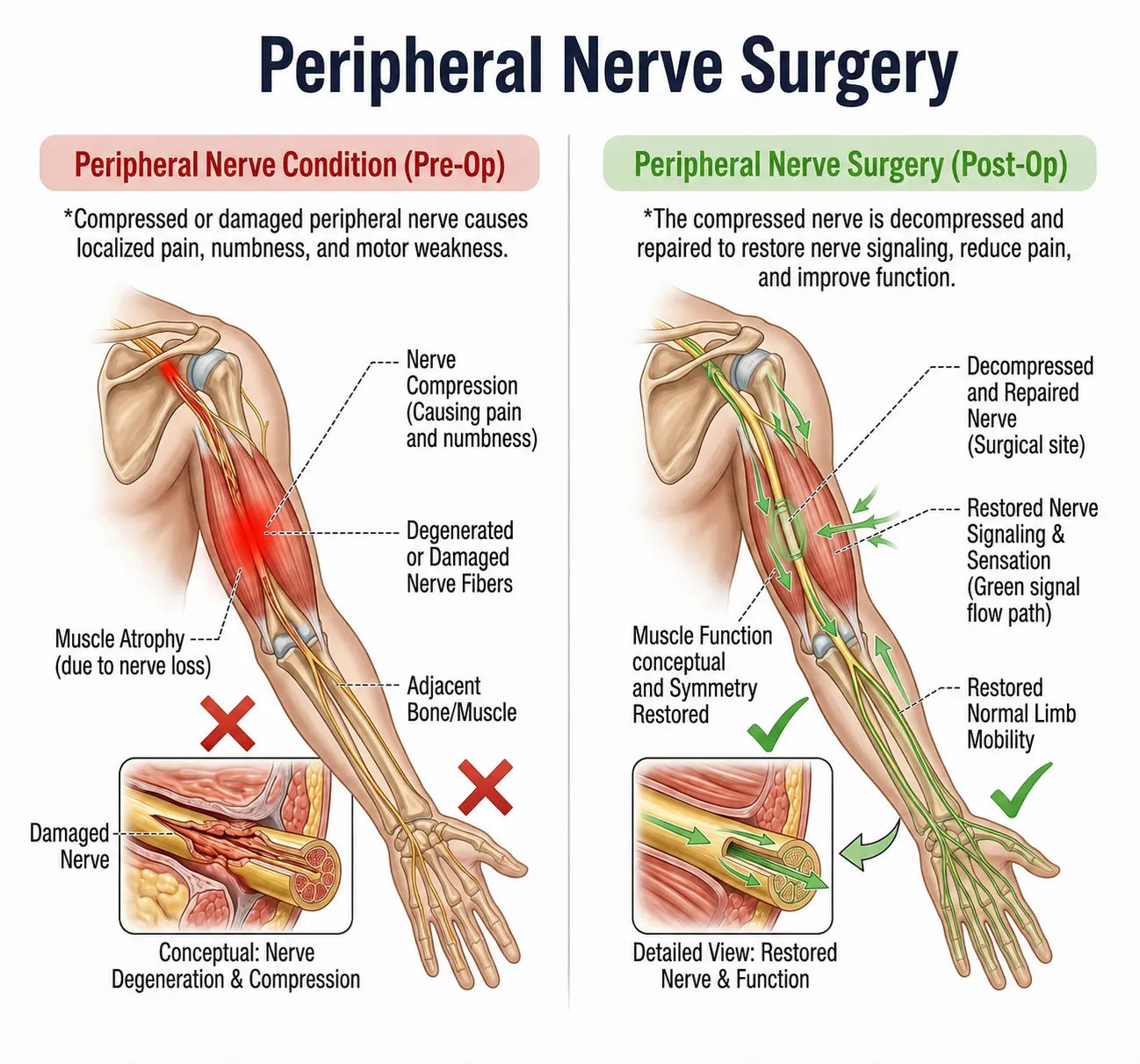









What is Peripheral Nerve Surgery?
Peripheral nerve surgery involves microsurgical techniques used to treat nerve compression entrapments (such as Carpal Tunnel or Cubital Tunnel Syndromes) or repair traumatic nerve lacerations and brachial plexus injuries. Using surgical microscopes and high-precision micro-instruments, neurosurgeons decompress pinched nerves, perform neurolysis (freeing nerve fibers from scar tissue), or stitch together damaged nerve fascicles.
Who Needs Peripheral Nerve Surgery?
Surgery is indicated when nerve compression or injury causes functional loss, muscle weakness, or unmanageable pain that fails to recover with conservative treatments.
Key clinical indicators include:
- Persistent numbness, burning, or muscle wasting in the hand or foot (e.g., Carpal Tunnel or Peroneal nerve entrapment).
- Traumatic nerve lacerations from glass, knife, or sharp object injuries with immediate loss of sensation and motor function.
- Brachial plexus injury from motor vehicle accidents resulting in weakness or paralysis of the shoulder, arm, or hand.
- Painful nerve tumors (schwannomas or neurofibromas) causing focal neurological deficits.
- Electromyography (EMG) and Nerve Conduction Studies (NCS) showing severe nerve conduction block or denervation.
Types of Peripheral Nerve Procedures
- Nerve Decompression / Release: Surgical division of tight fibrous bands or ligaments constricting a nerve (e.g., Carpal Tunnel Release, Cubital Tunnel Release).
- Direct Nerve Repair (Neurorrhaphy): Micro-suturing severed nerve ends together under magnification.
- Nerve Grafting: Using a segment of donor nerve (e.g., sural nerve from the leg) to bridge gaps between widely separated nerve ends.
- Nerve Transfer: Redirecting a functional nearby nerve branch to reinnervate a more critical paralyzed muscle.
Benefits of Peripheral Nerve Surgery
- Relief from severe chronic nerve pain, burning, and night-time dysesthesias.
- Prevention of irreversible muscle atrophy and permanent paralysis.
- Restoration of tactile sensation in fingertips and palms.
- Functional re-innervation of paralyzed limbs in complex brachial plexus trauma.
What to Expect Before Surgery?
Diagnostic workup ensures accurate localization of nerve pathology:
- Electrophysiological Testing: Nerve Conduction Velocity (NCV) and Electromyography (EMG) studies.
- High-Resolution Nerve Ultrasound & MRI Neurography: Visualizing nerve swelling, neuroma formation, or structural compression.
- Motor Mapping: Evaluating individual muscle group strength grades (0-5 scale).
Complete Procedure
The surgical procedure for a peripheral nerve release or repair involves:
- Local, regional block, or general anesthesia depending on the surgical site and complexity.
- Making an incision along the anatomical course of the affected nerve.
- Careful microsurgical dissection exposing the nerve proximal and distal to the site of entrapment or injury.
- Dividing constricting fascia/ligaments (decompression), or trimming scarred nerve ends and micro-suturing individual nerve fascicles using ultra-fine (9-0 or 10-0) sutures under a microscope.
- Haemostasis verification and cosmetic skin closure, followed by protective splinting if a repair or graft was performed.
What to Expect During Surgery?
Simple nerve releases take 30 to 60 minutes, whereas complex brachial plexus reconstructions or multi-level nerve grafts can last 4 to 8 hours.
Open Decompression vs Endoscopic Release
| Feature | Open Decompression | Endoscopic / Minimally Invasive Release |
|---|---|---|
| Incision Size | Standard direct incision (2-4 cm). | Mini-puncture incision (1-1.5 cm) with endoscope. |
| Visualization | Direct surgical microscope visualization. | Video display via camera inside the tunnel. |
| Palmar/Tissue Tenderness | Minor temporary pillar pain over scar site. | Reduced scar tenderness and faster return to grip. |
| Anatomical Safety | Ideal for recurrent or complex revisions. | Ideal for primary uncomplicated carpal tunnel cases. |
Success Rate and Safety
Decompression procedures like carpal tunnel release carry success rates over 90-95% for symptom relief. Nerve repair outcomes depend on patient age, distance to target muscle, and time from injury to repair (best results when performed within weeks of injury).
Peripheral Nerve Surgery Cost Estimate
| Procedure Type | Simple Decompression (INR) | Complex Repair / Grafting (INR) |
|---|---|---|
| Single Nerve Decompression (Carpal/Cubital) | ₹1,00,000 - ₹2,00,000 | ₹1,80,000 - ₹2,80,000 |
| Nerve Grafting / Brachial Plexus Surgery | ₹2,50,000 - ₹3,50,000 | ₹3,50,000 - ₹5,00,000+ |
Disclaimer: Procedure complexity, operative time, and micro-suture/nerve conduit consumables determine final hospital costs.
Recovery Guide & Post-Operative Care
Recovery Timeline
- Day 0-1: Same-day discharge for simple release; overnight stay for nerve repairs/grafts.
- Week 1-2: Splint or dressing maintenance; suture removal at 10-14 days.
- Month 1-3: Nerve regeneration progresses at a rate of approximately 1 mm per day; physical and occupational therapy initiated.
- Month 6-12: Sensory re-education and motor recovery evaluation during periodic follow-ups.
Post-Op Precautions & Care
- Immobilization: Keep splints intact if nerve repairs or grafts were performed to prevent tension across micro-sutures.
- Hand/Limb Elevation: Elevate the operated limb to reduce post-operative swelling.
- Physical Therapy: Diligent participation in hand therapy and sensory re-education exercises is critical for functional recovery.
Frequently Asked Questions
How fast do peripheral nerves heal after surgery?⌄
Peripheral nerves regenerate slowly at a rate of approximately 1 millimeter per day (about 1 inch per month) after repair.
Is carpal tunnel release surgery performed under general anesthesia?⌄
No, most simple carpal tunnel or peripheral nerve releases are performed under local anesthesia or regional nerve blocks with intravenous sedation.
What is the difference between a nerve decompression and a nerve graft?⌄
Decompression cuts tight surrounding tissue to relieve pressure on an intact nerve, while a nerve graft uses a donor nerve segment to bridge a gap where a nerve was completely severed.
Will my hand strength return to normal after peripheral nerve release?⌄
Yes, most patients regain grip strength and relief from numbness, though severe long-standing cases with muscle atrophy may take several months of therapy.
How long do I need to keep the operated arm in a splint?⌄
Simple releases require a splint for only 3 to 7 days, whereas nerve repairs or grafts require 3 to 4 weeks of immobilization to protect delicate micro-sutures.