




What is Parotidectomy?
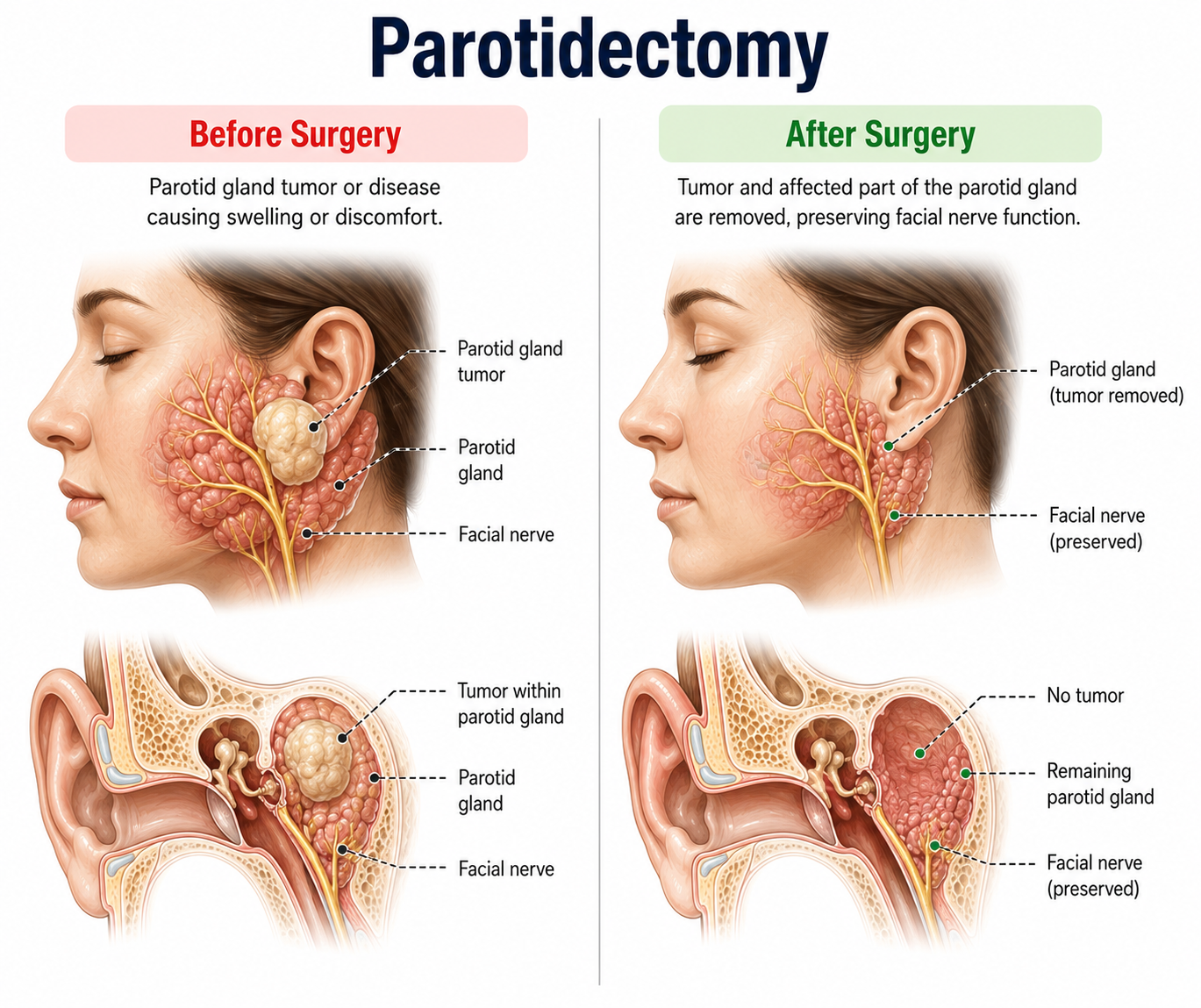
Parotidectomy is a delicate surgical procedure involving the partial or total excision of the parotid gland—the largest of the human salivary glands, located in front of and below the earlobe. The parotid gland is uniquely bisected into superficial and deep lobes by the branches of the facial nerve (Cranial Nerve VII), which controls all facial expressions. Parotidectomy requires micro-surgical dissection to remove tumors cleanly while meticulously isolating and preserving each branch of the facial nerve.
Who Needs Parotidectomy?
Parotidectomy is indicated for benign or malignant neoplasms, chronic calculus disease, or recurrent severe parotid gland infections.
Key clinical indicators include:
- Benign parotid tumors (e.g., Pleomorphic Adenoma, Warthin's Tumor).
- Malignant parotid carcinomas (e.g., Mucoepidermoid carcinoma, Adenoid cystic carcinoma).
- Rapidly expanding or painful mass in front of or beneath the earlobe.
- Chronic parotitis with sialolithiasis (salivary duct stones) resistant to conservative management.
- Parotid deep lobe lesions causing asymmetry of the lateral pharyngeal wall.
Types of Parotidectomy
- Superficial Parotidectomy: Removal of the gland portion superficial to the facial nerve (most common procedure for benign tumors).
- Partial Superficial Parotidectomy (Enucleation / Lumpectomy): Targeted removal of small benign superficial tumors with a surrounding healthy gland cuff.
- Total Parotidectomy: Complete removal of both superficial and deep lobes, required for deep lobe tumors or malignant lesions.
- Radical Parotidectomy: Complete gland removal along with sacrifice and grafting of the facial nerve if directly invaded by high-grade carcinoma.
Benefits of Parotidectomy
- Definitive removal of salivary gland tumors before malignant transformation or local tissue expansion.
- Complete cure for common benign lesions such as Pleomorphic Adenoma.
- Micro-surgical preservation of facial movement and expression.
- Relief from facial contour distortion, pain, or recurrent salivary duct blockages.
What to Expect Before Surgery?
Detailed pre-operative diagnostic mapping is vital to prevent facial nerve injury:
- Fine Needle Aspiration Cytology (FNAC) / Core Biopsy: Pathological tissue evaluation to distinguish benign from malignant histology.
- Contrast MRI / CT Scan: High-resolution imaging to evaluate tumor depth, relation to facial nerve plane, and deep lobe extension.
- Facial Nerve Function Assessment: Baseline clinical grading of facial muscle symmetry and eye closure.
- Medical Fitness: Standard pre-anesthetic blood tests, ECG, and chest X-ray.
Complete Procedure
The surgical procedure is performed under general anesthesia and takes approximately 2 to 4 hours:
- Administration of general anesthesia without long-acting muscle relaxants to permit continuous intraoperative facial nerve monitoring.
- Making a facelift-style skin incision (Modified Blair incision) starting in front of the ear and curving into the upper neck fold.
- Raising skin flaps to expose the parotid fascia.
- Identifying the main trunk of the facial nerve as it exits the stylomastoid foramen.
- Meticulously dissecting the parotid gland tissue off the 5 main facial nerve branches (temporal, zygomatic, buccal, marginal mandibular, cervical).
- Excising the tumor along with the superficial (or deep) lobe tissue.
- Placing a suction drain, repositioning skin flaps, and suturing the incision with fine cosmetic stitches.
What to Expect During Surgery?
Continuous intraoperative facial nerve monitoring (EMG) is utilized throughout the operation. Each nerve branch is electrically stimulated and visually identified before any tissue division.
Superficial vs Total Parotidectomy
| Feature | Superficial Parotidectomy | Total Parotidectomy |
|---|---|---|
| Surgical Scope | Removes gland lateral to facial nerve. | Removes both superficial and deep lobes. |
| Indication | Superficial lobe benign tumors (80% cases). | Deep lobe lesions or malignant cancers. |
| Facial Nerve Exposure | Dissection over anterior surface of nerve. | 360-degree dissection above and beneath nerve. |
| Transient Weakness Risk | Low to moderate (10–15% temporary). | Slightly higher temporary nerve weakness risk. |
Success Rate and Safety
Parotidectomy achieves a complete cure rate exceeding 95% for benign tumors. Permanent facial nerve injury in experienced hands occurs in <1-2% of benign tumor resections.
Parotidectomy Cost Estimate
| Procedure Complexity | Standard Surgery (INR) | Advanced / Nerve Monitored Surgery (INR) |
|---|---|---|
| Partial / Superficial Parotidectomy | ₹80,000 - ₹1,30,000 | ₹1,10,000 - ₹1,75,000 |
| Total Parotidectomy | ₹1,10,000 - ₹1,70,000 | ₹1,45,000 - ₹2,20,000 |
| Radical Parotidectomy + Nerve Graft / Neck Dissection | ₹1,60,000 - ₹2,50,000 | ₹2,10,000 - ₹3,20,000 |
Disclaimer: Final cost varies based on facial nerve monitoring equipment, hospital stay, and histopathology.
Recovery Guide & Post-Operative Care
Recovery Timeline
- Day 1-2: Suction drain in place; hospital stay observation; soft liquid diet.
- Day 3-4: Suction drain removal when output is minimal (<15ml/24hr); discharge home.
- Week 1-2: Cosmetic suture removal; temporary facial weakness (if present) begins to recover.
- Month 1-3: Facial incision scar matures; complete resolution of transient nerve neuropraxia.
Post-Op Precautions & Care
- Wound & Scar Care: Keep surgical incision clean and dry; apply silicone gel or sunblock after suture removal.
- Frey's Syndrome Awareness: Report any localized sweating or flushing on the cheek while eating (Frey's syndrome).
- Facial Exercises: Perform gentle facial expression exercises if temporary muscle weakness is present.
- Avoid Pressure: Avoid heavy pressure over the cheek or earlobe area.
Frequently Asked Questions
Will my face be paralyzed after parotidectomy?⌄
In over 85-90% of cases for benign tumors, facial nerve function remains normal or experiences only temporary mild weakness that resolves within weeks to months.
What is Frey's syndrome?⌄
Frey's syndrome (auriculotemporal syndrome) is a minor benign late side effect where severed autonomic nerve fibers misroute to sweat glands, causing flushing or sweating on the cheek while eating.
Where is the surgical scar located?⌄
The modified Blair incision is designed like a cosmetic facelift scar, hiding in front of the ear canal and curving gracefully behind the earlobe into the neck fold.
Is parotidectomy performed under local or general anesthesia?⌄
Parotidectomy is always performed under general anesthesia to ensure complete immobility and allow accurate facial nerve monitoring.
Why is fine needle biopsy (FNAC) needed before surgery?⌄
FNAC helps determine whether the parotid mass is benign or malignant, allowing your surgeon to plan the exact scope of surgery and nerve preservation strategy.