

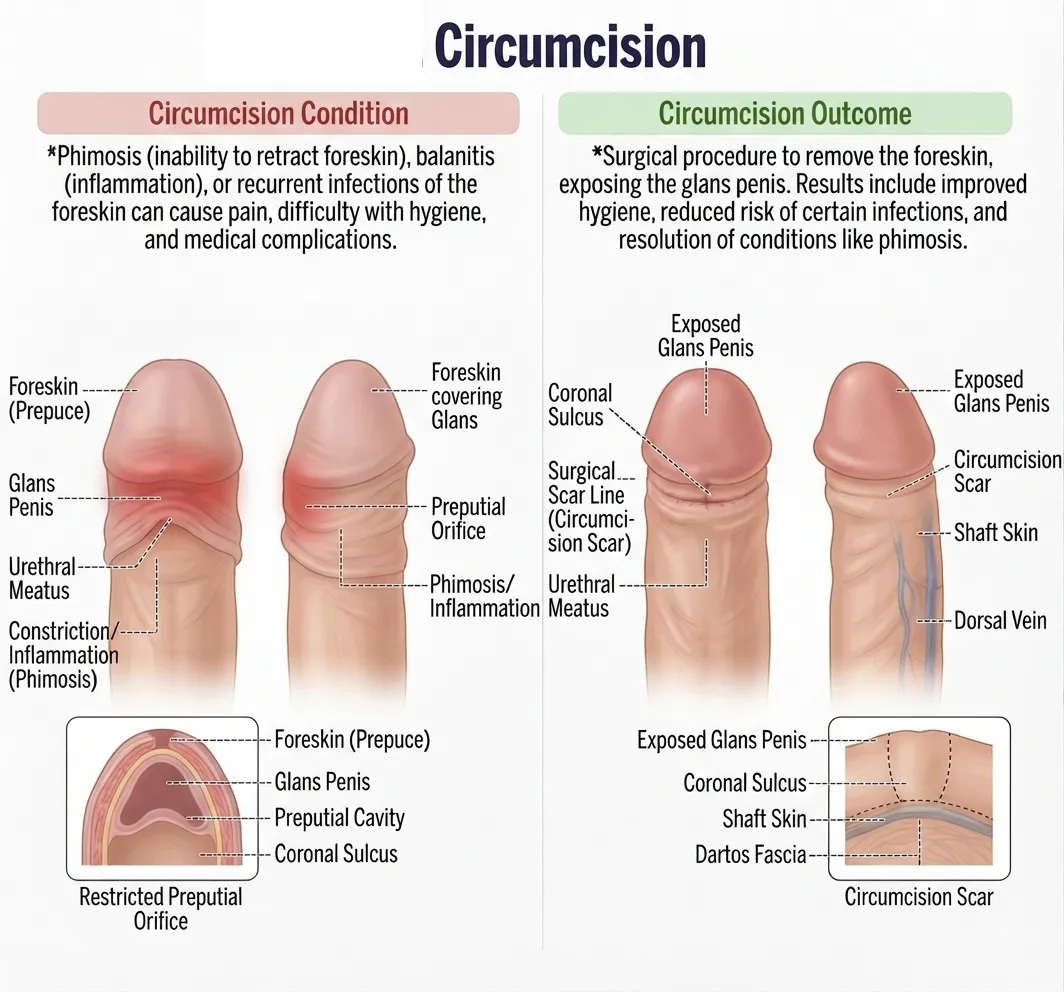









What is Circumcision?
Medical circumcision involves the partial or total surgical excision of the prepuce (foreskin) that covers the glans penis. In paediatric medicine, it is recommended when pathological tight foreskin causes functional obstruction, pain, or recurrent local/urinary tract infections.
Who Needs Circumcision?
While non-retractile foreskin is physiological in infants and young boys, surgical intervention becomes necessary when complications arise.
Key clinical indicators include:
- Pathological Phimosis (scarring/tightening preventing foreskin retraction beyond age 5–7).
- Recurrent Balanoposthitis (frequent infection/inflammation of the glans and foreskin).
- Ballooning of the foreskin during urination accompanied by straining or weak stream.
- Recurrent Urinary Tract Infections (UTIs) associated with anatomical foreskin tightness.
- Paraphimosis (trapped retracted foreskin causing swelling—a medical emergency).
Types of Circumcision
- Surgical Excision (Sleeve/Suture Method): Conventional precise surgical removal followed by dissolvable sutures.
- Plastibell / Device Technique: Placement of a plastic ring device (commonly used in neonates and younger infants).
- Laser-Assisted Circumcision: Use of high-precision energy for tissue excision with minimal bleeding.
- ZSR / Stapler Circumcision: Modern mechanical stapler technique offering uniform cut and suture-free ring application.
Benefits of Circumcision
- Relief from painful urination, ballooning, and recurrent local infections.
- Decreased risk of recurrent urinary tract infections in susceptible children.
- Enhanced local hygiene maintenance.
- Prevention of emergency paraphimosis episodes.
What to Expect Before Surgery?
- Clinical Evaluation: Assessment of penile anatomy to rule out underlying hypospadias (where circumcision is contraindicated before repair).
- Pre-Op Fasting: Adherence to standard paediatric fasting guidelines based on age.
- Hygiene & Preparation: Gentle washing of the area prior to admission.
Complete Procedure
The surgical steps generally involve:
- Administration of general or regional anaesthesia (penile nerve block) for pain elimination.
- Cleaning and sterilizing the genital area.
- Gently separating adhesions between the glans and inner foreskin.
- Removing the redundant foreskin tissue precisely using chosen surgical method.
- Securing haemostasis (stopping bleeding) and placing dissolvable sutures or device ring.
- Applying an antiseptic ointment and protective petroleum-gauze dressing.
What to Expect During Surgery?
The procedure takes approximately 20 to 30 minutes. In infants and children, general anaesthesia ensures complete immobility and comfort throughout the procedure.
Conventional vs Stapler/Device Circumcision
| Feature | Conventional Surgery | Stapler / Device Method |
|---|---|---|
| Procedure Time | 25–40 minutes. | 10–15 minutes. |
| Bleeding Risk | Minimal (controlled with cautery/sutures). | Negligible. |
| Sutures | Dissolvable sutures required. | Silicone ring / staples fall off automatically. |
| Healing Appearance | Smooth, hand-tailored finish. | Highly uniform circular cut edge. |
Success Rate and Safety
Circumcision is a standard procedure with a success rate near 100%. Complication rates are extremely low when performed by trained surgeons.
Circumcision Cost Estimate
| Procedure Modality | Cost Range (INR) |
|---|---|
| Conventional Surgical Circumcision | ₹25,000 - ₹45,000 |
| Laser / Advanced RF Circumcision | ₹35,000 - ₹55,000 |
| ZSR / Stapler Device Circumcision | ₹40,000 - ₹75,000 |
Disclaimer: Estimated costs depend on child age, chosen technique, and day-care admission charges.
Recovery Guide & Post-Operative Care
Recovery Timeline
- Day 0: Discharge home on the same day after voiding urine successfully.
- Day 1–3: Mild redness and glans sensitivity; regular pain medication keeps child comfortable.
- Week 1: Reduction in local swelling; stitches or ring start dissolving/separating.
- Week 2: Complete surface skin closure; normal baths and full activity resume.
Post-Op Precautions & Care
- Ointment Application: Apply prescribed antibiotic/petroleum jelly with diaper changes or briefs.
- Looser Clothing: Wear loose-fitting bottoms or soft diapers to avoid friction.
- Hygiene Care: Gently pour warm water over the area during bathing after initial 48 hours; avoid scrub rubbing.
Frequently Asked Questions
Is tight foreskin in toddlers always a reason for circumcision?⌄
No, foreskin tightness is normal in babies and toddlers. Surgery is only needed if there are symptoms like pain, ballooning, or infections.
How long does healing take after paediatric circumcision?⌄
Initial skin healing takes about 7 to 10 days, with complete recovery and tissue softening over 2 to 3 weeks.
Will my child feel pain during the procedure?⌄
No, the surgery is performed under general anaesthesia combined with a local nerve block for post-operative pain relief.
When will the sutures or ring fall off?⌄
Dissolvable sutures or stapler rings naturally drop off within 10 to 14 days without requiring manual removal.
Can my child bathe after the operation?⌄
Sponge baths are recommended for the first 48 hours, followed by gentle warm water baths as advised by the doctor.