

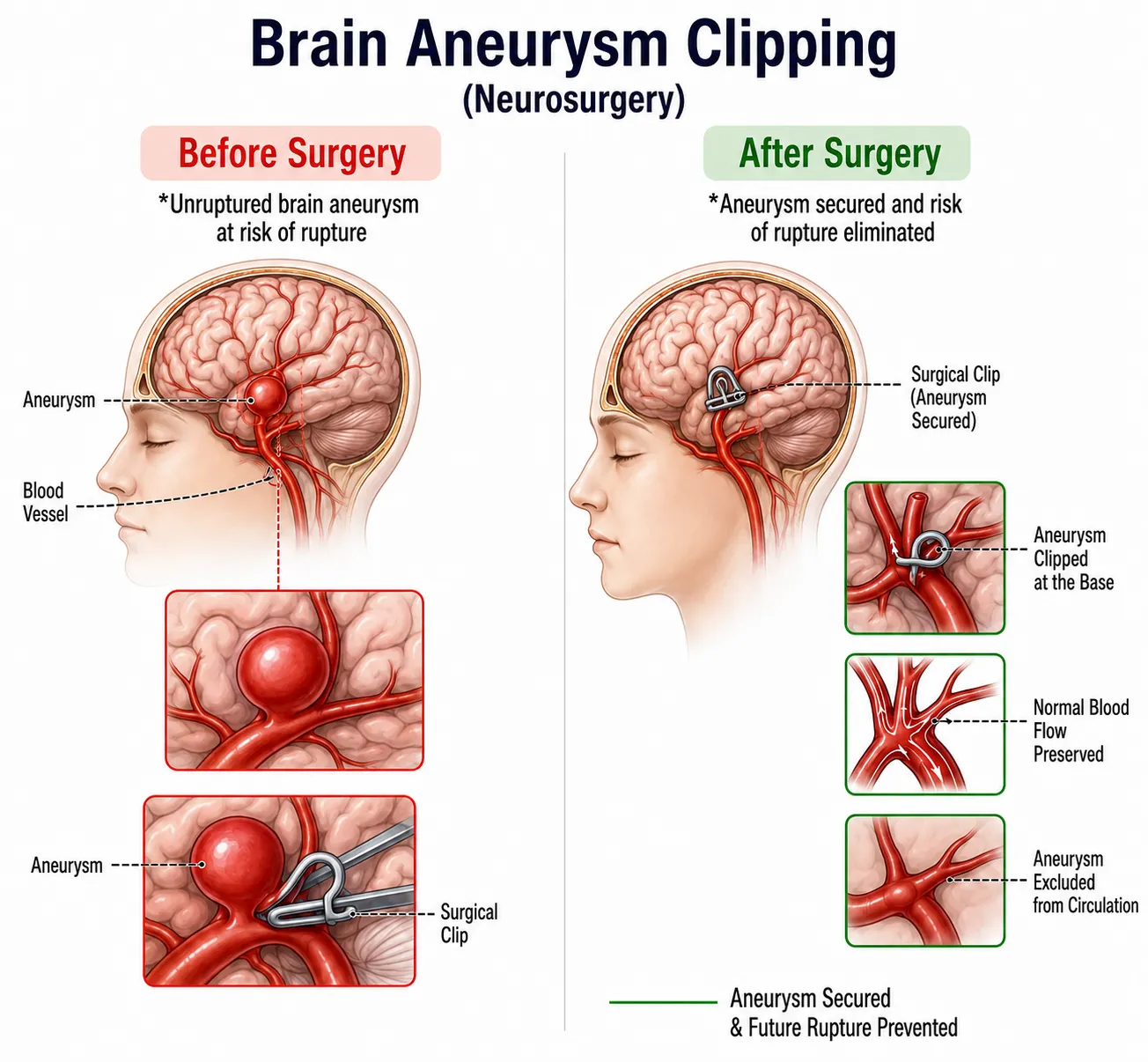









What is Brain Aneurysm Clipping?
Brain Aneurysm Clipping is a surgical technique designed to treat intracranial cerebral aneurysms—weakened, bulging spots on brain arteries. During the procedure, a neurosurgeon performs a craniotomy to reach the brain's vascular network under a high-power surgical microscope and applies a permanent, spring-loaded titanium clip across the base (neck) of the aneurysm. This seals off blood flow, eliminating the risk of aneurysm growth or rupture.
Who Needs Brain Aneurysm Clipping?
Aneurysm clipping is performed either as an emergency intervention following a subarachnoid hemorrhage (ruptured aneurysm) or as a preventive measure for unruptured aneurysms.
Key clinical indicators include:
- Acute subarachnoid hemorrhage presenting with a sudden, severe "worst headache of your life" (thunderclap headache).
- Unruptured aneurysms >7mm, or rapidly growing aneurysms identified on CTA/MRA.
- Aneurysms located at arterial bifurcations (e.g., MCA or ACA) where surgical clip placement offers superior anatomical closure.
- Symptomatic unruptured aneurysms causing cranial nerve compression (e.g., eye pain, double vision, or pupil dilation).
Types of Brain Aneurysm Interventions
- Microsurgical Clipping: Direct open access to apply permanent spring-loaded titanium clips across the aneurysm neck.
- Endovascular Coiling: Minimally invasive catheterization packing platinum coils inside the aneurysm sac.
- Flow Diverter Stenting: Placement of a specialized fine-mesh stent across the parent artery to divert blood flow away from large or complex aneurysms.
Benefits of Brain Aneurysm Clipping
- Immediate, permanent exclusion of the aneurysm from cerebral blood pressure.
- Lowest rate of recurrence and re-treatment compared to endovascular techniques.
- Durable protection lasting a lifetime without requiring repeat interventions.
- Allows removal of surrounding blood clots in acute ruptured cases to reduce vasospasm risk.
What to Expect Before Surgery?
Preparation depends on whether the presentation is elective (unruptured) or an emergency (ruptured):
- 4D Neurovascular Imaging: Digital Subtraction Angiography (DSA) or 3D CT Angiography to map parent vessels and aneurysm orientation.
- Neurological & Hemodynamic Stabilization: Control of blood pressure to reduce re-rupture risk prior to clipping.
- Surgical Planning: Identifying optimal skull entry trajectories (e.g., Pterional, Keyhole, or Supraorbital approach).
Complete Procedure
The surgical procedure follows these steps:
- General anesthesia and fixed positioning of the head in a stereotactic pin frame.
- Craniotomy incision (e.g., pterional craniotomy near the temple area).
- Opening the dura mater and gently separating natural brain folds under an operating microscope without cutting brain tissue.
- Locating the parent artery and carefully dissecting the aneurysm neck away from surrounding micro-vessels and cranial nerves.
- Microscopic application of a biocompatible titanium clip across the aneurysm neck.
- Intraoperative micro-Doppler or Indocyanine Green (ICG) angiography to verify complete aneurysm occlusion and normal blood flow in surrounding arteries.
- Replacing the bone flap and closing skin layers cleanly.
What to Expect During Surgery?
Micro-dissection and clipping require extreme precision and take between 3 and 6 hours. Intraoperative electrophysiological monitoring safeguards nerve and brain function.
Surgical Clipping vs Endovascular Coiling
| Feature | Microsurgical Clipping | Endovascular Coiling |
|---|---|---|
| Approach | Open surgical craniotomy. | Closed catheter puncture through femoral/radial artery. |
| Durability | Extremely high; permanent single-session cure. | Requires follow-up scans; small risk of coil compaction/recurrence. |
| Anatomical Fit | Ideal for wide-necked or branch point aneurysms. | Ideal for narrow-necked, deep, or posterior circulation aneurysms. |
| Hospital Stay | 5-7 days (unruptured); longer for ruptured. | 2-3 days (unruptured). |
Success Rate and Safety
Surgical clipping achieves complete occlusion rates exceeding 95% for unruptured aneurysms. Permanent clip placement carries a recurrence rate of less than 1-2% over decades.
Brain Aneurysm Clipping Cost Estimate
| Procedure Type | Unruptured Elective Clipping (INR) | Ruptured / Emergency Clipping (INR) |
|---|---|---|
| Single Aneurysm Titanium Clipping | ₹4,50,000 - ₹7,00,000 | ₹6,50,000 - ₹9,50,000 |
| Complex / Multiple Aneurysm Clipping | ₹6,00,000 - ₹8,50,000 | ₹8,00,000 - ₹11,00,000+ |
Disclaimer: Ruptured aneurysm management costs are significantly higher due to extended Neuro-ICU stays, vasospasm monitoring, and medication needs.
Recovery Guide & Post-Operative Care
Recovery Timeline
- Day 0-3: ICU monitoring for neurological function, fluid balance, and blood pressure control.
- Day 4-7: Step-down to room/ward; gradual mobilization and monitoring for vasospasm in ruptured cases.
- Week 2-6: Wound healing and staple removal; baseline activity resumption for unruptured cases.
- Month 3-6: Complete neurological recovery and return to work/driving upon neurosurgical clearance.
Post-Op Precautions & Care
- Vasospasm Vigilance: In ruptured cases, strict fluid protocols and nimodipine medication are maintained for 21 days.
- Incision Care: Protect temple/scalp incisions from moisture and direct pressure.
- Physical Exertion: No heavy lifting (>5 kg) or high-impact activity for 8-12 weeks.
- Follow-up Imaging: Post-operative DSA or CTA at 3 to 6 months to confirm 100% occlusion.
Frequently Asked Questions
What is the titanium aneurysm clip made of, and will it set off metal detectors?⌄
Aneurysm clips are made of high-grade biocompatible titanium alloys. They do not set off airport security metal detectors and are safe for future MRI scans.
Is aneurysm clipping a permanent cure?⌄
Yes, once a clip is successfully applied across the aneurysm neck, it remains in place permanently, and the aneurysm almost never recurs.
How long does it take to recover from an unruptured aneurysm clipping?⌄
Most patients with unruptured aneurysms spend 4 to 6 days in the hospital and achieve full recovery within 4 to 8 weeks.
What happens if a brain aneurysm ruptures before surgery?⌄
A ruptured aneurysm is a life-threatening medical emergency requiring immediate hospitalization, blood pressure stabilization, and emergency clipping or coiling within 24 hours.
Can I get an MRI scan after having a titanium aneurysm clip?⌄
Yes, titanium clips are MRI-safe up to standard 1.5T and 3.0T magnetic field strengths. You will receive an implant ID card detailing your clip specification.